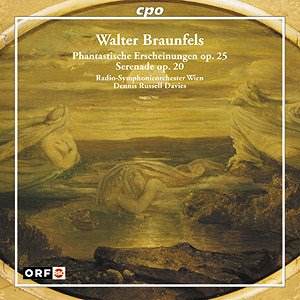
You might know Braunfels’
name: his opera Die Vögel was
included in Decca’s outstanding Entartetemusik
series. In fact it was Braunfels’
opera that made his name, if briefly,
during the first half of the last century.
The operas are: Ulenspiegel (1913);
Die Vögel (1920); Don
Gil von den Grünen Hosen (1924);
Der Gläserne berg (1929);
Galathea (1929); Der Traum
ein Leben (1937); Szenen aus
der Leben der Heiligen Johanna (1943);
Verkündigung - Ein Mysterium
(1945) and Der Zauberlehrling
(1954). His oratorios are also reportedly
well worth revival: Offenbarung Johannis
(1919) and Spiel von der Auferstehung
(1954).
The Phantastiche
Erscheinungen eines Themas von Hector
Berlioz (or Fantastic Appearances
of a Theme by Berlioz) was premiered
in Zurich in 1920. The Berlioz theme
is from the Song of the Flea from
The Damnation of Faust. The music
is a grand, even overblown, orchestral
fantasy. The opulent indulgence sits
somewhere between Strauss’s Ein Heldenleben,
and Don Quixote, Bruckner and
Schumann. The shade of late Beethoven
also passes wistfully through these
pages - especially the Choral Symphony
and, from earlier, Egmont.
From time to time the music takes on
an Elgarian nobility especially in the
first two movements and the finale.
The latter grasps nobility with conviction
- somehow bridging the gap between Strauss’s
Don Juan and Elgar’s Falstaff.
Quite why it was necessary to omit the
ninth Erscheinung I do not know
- even if it was a customary elision
when the work was first being performed.
The twelfth Erscheinung quotes
the melody Für’s Vaterland zu
sterben (To Die for the Fatherland)
reminding us that the work was written
during the Great War. It also reminds
us that largely unexplored is the effect
of the Great War on German music of
then contemporary composers. It is a
bit of an unnerving confection, with
the jocular jostling with the apocalyptic.
Not fully successful but an interesting
listen nonetheless.
The four movement Serenade
steers well clear of anything
in the way of rodomontade. It is a sunny
and very successful work reflecting
the happiness of the composer’s recent
marriage. It achieves a remarkably centred
stillness in the Ruhig third
movement. Braunfels was happy working
gently within the mood and expressive
confines of a style we now associate
with Elgar’s shorter orchestral works,
and those of Goldmark, Huber and Massenet.
Beethoven’s Pastoral Symphony might
also have been somewhere at the back
of the composer’s mind too.
Braunfels was a German
composer, born in Frankfurt-am-Main,
who studied in his birthplace, with
Leschetizky in Vienna and with Thuille
in Munich. He found his metier as director
of the Cologne Academy of Music with
Hermann Abendroth. This lasted from
1925 to 1933 when political issues swept
him out. He returned to that position
in 1945 and retained it until his retirement
in 1950.
These two rather backward-looking
works are enthusiastically performed
and will provide romantic rewards for
the curious.
Rob Barnett



 Vienna Radio Symphony Orchestra/Dennis Russell
Davies
Vienna Radio Symphony Orchestra/Dennis Russell
Davies