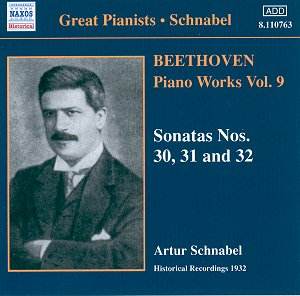
It appears the last
sonatas are not only the summit’s of
Beethoven’s achievement in the sphere
of the piano sonata; they crown Schnabel’s,
too. Whatever the merits - and there
are many - of previous volumes in this
invaluable series, this is, aptly, its
crowning glory. Schnabel’s grasp of
Beethoven’s processes has rarely been
equalled in the history of recorded
sound and it is a privilege to be able
to experience these interpretations
in Mark Obert-Thorn’s exemplary transfers.
Hiss is low but there - reassuringly
so - but it is the quality of the reproduction
of piano tone that impresses. Concomitant
with that is the appreciation we can
now have of Schnabel’s tonal variety.
Technically, there may be slips but
in this context they are completely
irrelevant.
The last three sonatas
are hard work if heard one after the
other; not usually a course I would
recommend, but Schnabel makes it remarkably
difficult to turn off.
Op. 109 is the ideal
way to begin a disc, easing in as it
does here. Schnabel’s true pianissimi
make for a world of the utmost intimacy;
the return of the opening material at
3’00 is magical. The Prestissimo second
movement is true contrast, with no sense
of the awkwardness often heard here.
Schnabel carries his conception through,
stopping for nothing. It is all highly
impressive; as is the finale, gorgeous
without self-indulgence, a real transportation
to realms rarely glimpsed by humans.
Fast passages reveal Schnabel’s sterling
fingerwork, but it is the sense of space,
the grasp of the shape of the work that
really impresses. And was that a tear
in my eye at the arrival around 9’44?
That doesn’t happen too often to hardened
reviewers, I can tell you. Technically,
the bass trill around 8’32 is magnificent,
full of energy. The sense of rest at
the end has to be heard to be believed.
Comparisons are largely
irrelevant. For a more ‘modern’ interpretation,
Pollini’s famous DG recordings of the
late sonatas fully deserve their reputation,
and many people (not me) swear by Richard
Goode. Brendel has long been persuasive
in this repertoire. But Schnabel begs
to be heard.
In the case of Op.
110 the piano positively sings in the
first movement. The recording copes
with fortes very well, and left-hand
definition is remarkable considering
the 1932 date. The coexistence of delicacy
and power in this movement encapsulates
an important aspect of late Beethoven
and Schnabel is keen to present it in
stark terms.
Certainly there are
technical (accuracy) problems in the
tricky second movement, but perhaps
less that one might imagine. The finale
includes serene calm and thunderous
climax. This is earth-shattering music-making.
Perhaps the miracle
of this disc is that as one listens
to each sonata it is perfect in itself,
yet there is a real sense of closure,
not just of the individual sonata but
of the cycle, at the end of Op. 111.
From the beginning of this last sonata,
Schnabel has his ears on the long-term.
There have been more dramatic openings,
but this is the beginning of a long
journey. All of which is to contrast
with the second and last movement, where,
somehow, Schnabel effects an immediate
sense of repose. It is marvellous the
way the music seems to emerge from within
itself; like watching a butterfly emerge
from a chrysalis, but in sound. This
particular passport to Heaven is to
be cherished.
A reminder of Schnabel’s
true greatness. Magnificent.
Colin Clarke



 Artur
Schnabel (piano).
Artur
Schnabel (piano).