Strange
that so many composers favoured the
viola - think of Bach, Mozart, Dvořák,
Hindemith … - but so few wrote much
music for it. Strange too, given the
beautiful sound they can create, that
violists are the butt of innumerable
silly jokes among orchestral
musicians. The suggestion is, of course,
that violists tend to hide in the middle
of the orchestral texture, where (supposedly…)
nothing much happens, and nothing much
matters. And if you’re the shy type,
you’re okay, cos there’s so little solo
music written for your instrument.
Nobuko Imai demolishes
all this nonsense by playing the six
suites Bach wrote for unaccompanied
cello up the octave - and how better
to plug a conspicuous repertory gap
with a towering masterpiece? - and by
playing them with commanding - even
extrovert - authority!
Non-technical readers
may not be aware that the viola tunes
its strings to the same C, G, D and
A - each a fifth higher than the other
- as the cello. So Imai’s ‘arrangement’
consists simply of writing the pieces
out afresh in the alto (rather than
bass) clef: absolutely no alterations
are required. The only complications
arise in the Sixth Suite, which was
written for a five-string cello - a
problem for a four-string cellist as
much as for a four-string violist, and
usually solved or rather bypassed by
playing it on a standard instrument,
even if that means a bit of a struggle!
Don’t assume that,
simply because the ‘notes’ transfer
so simply that it automatically follows
that it ‘works’ as well. The cello’s
lowest strings resonate powerfully,
providing what passes for a sustained
bass (but actually isn’t) in arpeggiated
or contrapuntal cross-string writing.
So, on the cello, the G major’s opening
Prélude resonates sufficiently
to sound almost like four-part organ
harmony: and the C major’s Bourrées
and Gigue have an appealingly
rustic quality on account of the sheer
weight of the bass voice. The viola
just can’t match this, so you could
argue that we get rather less overtly
harmonic and rhythmic information, simply
because of its smaller size. On the
other hand, a modern cello (or, rather,
a modern bow) makes quite a meal of
multiple stops, whereas the viola produces
a lot more attractive sound in such
material, being far more forgiving,
and better able to play three or four
notes literally at the same time. And
high lying lines sing every bit as well
on the viola as the cello. So, all in
all, a case of swings and roundabouts.
What matters most is
that Nobuko Imai is the perfect ‘salesperson’.
Her intonation is spotless, her sense
of style is beyond reproach, and her
characterising of the various dance
movements judged to perfection. She
bridges the gap between old-time expressive
indulgence and latter-day historically-informed
performance practice, and is likely
to satisfy discerning listeners from
both schools of thought.
I recommend this whole-heartedly.
If you’ve already got the unaccompanied
violin Sonatas and Partitas and the
unaccompanied cello Suites, what better
company for them than this? But, when
you put it upon your CD shelves, remember
to put it between them!
Peter J Lawson



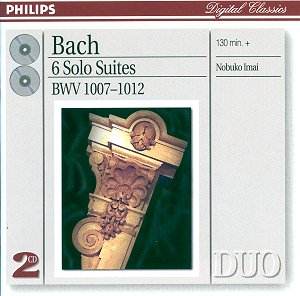
 Nobuko Imai (viola)











