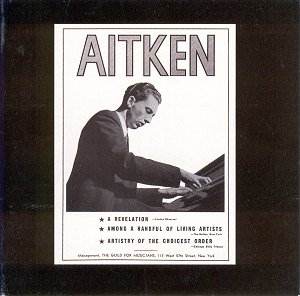
Webster Aitken was
a Californian, born in Los Angeles in
1908. Though he studied locally and
for a year at Curtis (with Herbert Simpson)
the bulk of his advanced studies were
in Berlin where he worked under von
Sauer and Marie Prentner, Leschetizky’s
erstwhile assistant. He’s most remembered
however as a student of Schnabel and
for his proselytizing all-Schubert recitals
– he gave a four-concert Sonata cycle
in London in 1938, the city’s first.
Back in America he racked up some prestigious
concerto and recital engagements but
after the War turned more to teaching
and to propagating new music. He premiered
Elliot Carter’s Piano Sonata in 1947
and gave the first known performance
of Ives’ Four Transcriptions from
Emerson. In his mid fifties he
withdrew from active concert life and
died in New Mexico in 1981.
His recordings were
for small labels and were few. Live
recital performances were reissued by
Delos on LP and other recordings are
known to exist; a 1939 Mozart Concerto
broadcast for instance has been preserved
but hasn’t yet been issued. In the main
though Aitken is a pianist only obscurely
remembered and then in terms of his
recorded legacy, perhaps imperfectly.
Nothing seems to have survived for example
of his more challenging interests in
contemporary music, with the exception
of some Copland and the Webern Op.27
Variations, though the survival of these
Schubert studio recordings is just,
given his propagandising work in the
late 1930s. Both these late sonatas
were taped circa 1950 in New York for
EMS and are apparently making their
first ever re-release. The Beethoven
sonatas are live concert performances
from the days of Aitken’s teaching and
college-performing fifties and are similarly
making their first appearance here.
Op.101 is interesting
in the divergences from Schnabel’s own
playing; Aitken was very much his own
man, of course, and in tempo terms he
cleaves more to Kempff’s tempo than
the older man’s. That however is about
all there is in terms of resemblance;
in the opening movement Aitken refuses
to let phrases flow and is deliberately
static and abjures wide dynamic variance
though he’s certainly a much more fluent
pianist in the second movement march
than his accident prone teacher ever
was. Though he makes a show of depth
in the slow movement his performance
is rather heavily phrased and pedalled
and lacks Schnabel’s richly voiced and
sustained intensity of utterance. We
can forgive the hash at the beginning
of the finale but maybe not the rather
peculiarly overstated view Aitken insists
on imposing on it.
Aitken is certainly
not cut from Schnabelian expression
in Op.110 where he isn’t especially
interested in romanticised playing or
overtly demonstrative music making.
His flurried playing of the central
movement is rhythmically out of control
but is maybe meant to convey the sheer
wildness of the music making. In his
Beethoven playing one can make some
kind of connection with another maverick
player, the Swiss Ernst Levy, whose
profoundly intellectualised performance
are far more problematic but also manage
to push one’s experience of Beethoven
playing to undreamt of extremes. What
Aitken seems to lack is cantabile, the
rhythmically steady unfolding of melodic
lines; his Adagio in Op.110 lacks moving
simplicity and in the Fuga his rhythms
become excitingly blurred.
The Hammerklavier
opens with a mad hell-for-leather
charge across the bar lines without
any rests; this level of impaction is
visceral and also idiosyncratic to the
point of perversity. Where Kempff prefers
neatness and Schnabel portentous, if
untidy, control and where Solomon delivers
magisterial and patrician eloquence,
Aitken rides roughshod through the opening
movement. His anti-romantic slow movement
is a compound of some rhetorical drama
and quite hard and fleet playing. He’s
certainly not over given to any molto
sentimento indication and the primary
impression one takes of his Beethoven
playing, if one accepts rhythmic instabilities
as inherent, is of a tough, rather off-putting,
cold and uneven musician.
I find his Schubert
more convincing, though still highly
personalised. A number of his voicings
in D959 are idiosyncratic to say the
least. Here though he seems more stable
in rhythm than in Beethoven, with playing
in the main that’s straightforward,
cool, somewhat clinical. The Andantino
receives a performance of clipped detachment,
rather formal, with not much pedal,
some rubati that will not necessarily
please - and are no substitute for timbral
warmth - insistent halts, and staccato-ish
articulation. There’s none of Kempff’s
measured if occasionally aloof warmth,
much less Schnabel’s huge gravity. After
a great Schubertian Aitken’s playing
in the finale can sound, whilst not
uninteresting, perhaps a touch prosaic
and lacking in imagination. The B flat
major D960 opens in extrovert and very
public fashion though his rhythm can
race alarmingly. Once again though the
slow movement finds him rather curt,
abrupt and unengaging. There’s a great
deal of difference between attempting
a corrective to overtly sentimentalised
performances of the slow movements in
late Schubert and withdrawing altogether
into inert detachment. So, banish thoughts
of Kempff, Curzon (another Schnabel
pupil) or Schnabel himself, much the
slowest of this august trio.
As for the recordings,
the 1950 discs are in somewhat murky
sound; not objectionably so, but with
reduced range and rather boxy. The Schuberts
come with a live acoustic, scarping
chairs and some coughs; again rather
par for the course for an amateur set
up. And yet. Whilst I don’t warm to
Aitken at all, other significant judges
did. B H Haggin for example admired
him enormously, as did Virgil Thomson.
Maybe the essence of his intractable
pianism doesn’t fully come across in
these performances – perhaps we lose
something of his withdrawn individualism.
Whatever may be the case, Bandoneon
has done Aitken proud in this two-disc
set, copiously annotated, which includes
a reprinted Aitken essay, a small biography,
and a "lineage" of great Beethoven
and Schubert pianists on record that
is interesting to read and seldom easy
with which to disagree. Clearly their
determination to present his recordings
is a labour of love and admiration.
There are also other performances of
his to which one can listen on their
website – from which this set is available.
As they say on the adverts, you can’t
buy this in the shops.
Jonathan Woolf



 Webster Aitken (piano)











