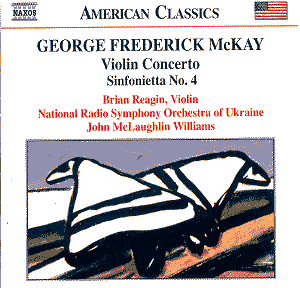
George Frederick McKay’s
music is not likely to be familiar to
those outside the USA unless they have
already heard the other two Naxos discs
issued over the last eighteen months.
Enterprising Naxos must be credited
with giving McKay’s reputation one of
its biggest ever boosts, certainly since
the composer’s death thirty five years
ago.
So for those who do
not know his music, what is it like?
Well, the Violin Concerto, the main
work here, is late-romantic in style;
very late. It is not unlike Korngold’s
better known work of slightly earlier
(1937) which was revised five years
after McKay’s in 1945. McKay spent nearly
all his life in his native Washington
State, most of it as a university professor
in Seattle, a relative musical backwater.
Korngold, Austrian émigré,
together with so many other musicians
from the German-speaking world, was
living just down the coast in the service
of Hollywood. Their compositional styles
are not a million miles away. One of
the most obvious differences is that
the textures of McKay’s concerto are
less thick than those in the Korngold
work and there are fewer of Korngold’s
squelchy romantic harmonies. Some might
regard that as a virtue. However, I
will stick my neck out and suggest that
those who enjoy Korngold’s Violin Concerto
are bound to be impressed by McKay’s.
In spite of the relative
clarity of texture, it could be possible,
in performance, to over-romanticise
the music with, for example, indulgent
lush string tone. The Ukrainians do
not do this – their strings are fairly
thin in tone but I do not mean that
pejoratively. The whole performance
is convincing: conductor, soloist and
orchestra in accord interpretively.
Brian Reagin, a man who manages to combine
a distinguished solo career with the
leadership of the North Carolina Symphony
Orchestra, gives a most persuasive account
of a work that I have never heard before.
The Suite on Sixteenth
Century Hymn Tunes is a lighter
work for double string orchestra. It
started life as an organ piece. Although
based on themes of Frenchman Jean Bourgeois,
to English ears it will have something
of Tudor pastiche about it, with hints
of Granville Bantock (1868-1946). On
hearing the opening modal-sounding Méditation
movement, listeners cannot help
being reminded of Vaughan Williams’
famous Tallis Fantasia. I found
it delightful listening in its own right.
The Sinfonietta,
like the concerto, is in classical fast-slow-fast
form, the first movement characterised
by rhythmic drive and a certain neo-classic
rigour. The second movement, pastoral
in style, has a richness of both texture
and ideas.
So far we have had
three works that are, within the context
of a conservative style for the period,
quite different in nature. Put these
together with the music of Naxos’s other
two McKay discs showing native influences
such as Jazz and pop, then we have a
composer displaying an eclecticism of
which Leonard Bernstein might have been
proud. What Bernstein knew of his music
though, I have no idea. Perhaps someone
could tell me.
The final work is a
single movement lasting a quarter of
an hour. It is a programmatic, rhapsodic,
pastoral piece evoking the stirring
of spring over the "brooding landscape"
of the plains. On first hearing, it
seems to me a distinguished example
of the nature genre. The use of a piano
is innovative, especially in the fact
that it plays the role of a meadowlark.
Western music has always associated
birds with wind instruments, specifically
reed ones. The piano tends to play in
high register to suggest elevation and
flightiness. Mind you, this might be
pragmatism rather than innovation. The
work was a commission to celebrate the
centennial of the Steinway Piano Company.
It is a typical Naxos
touch that in leading a revival of the
music of an American composer from North-West
U.S.A., a Ukrainian Orchestra is employed,
recording in Kiev which is as near as
dammit on the opposite side of world
from Seattle. One might have had doubts
about this, but the players, under their
American conductor John McLaughlin Williams,
appear astonishingly at home with this
unfamiliar music. Having already recorded
one orchestral disc, they must now be
considered world experts in the playing
of McKay’s music. Congratulations to
them and to Naxos for this deserved
revival.
John Leeman
see also
George
Frederick McKAY (1899-1970)
Caricature
Dance Suite (1924)From My Tahoe
Window - Summer Moods and Patterns,
Americanistic Etude (1924) An April
Suite (1924) Dance Suite No. 2 (1938)
Dancing in a Dream (1945) Excerpts
from Five Songs for Soprano (1964)
Every Flower That Ever Grew (1969)
Suite for Viola and Piano (1948)  William Logan, Logan Skelton, Sanford
Margolis (piano) Joan Morris (mezzo-soprano)
Mahoko Eguchi (viola) rec July 1999-Feb
2001, The Brookwood Studio, Ann Arbour,
MI, USA DDD
NAXOS AMERICAN CLASSICS 8.559143
[64.00] [RB]
William Logan, Logan Skelton, Sanford
Margolis (piano) Joan Morris (mezzo-soprano)
Mahoko Eguchi (viola) rec July 1999-Feb
2001, The Brookwood Studio, Ann Arbour,
MI, USA DDD
NAXOS AMERICAN CLASSICS 8.559143
[64.00] [RB]
George
Frederick McKAY (1899-1970)
From A Moonlit Ceremony (1945) Harbor
Narrative (1934) Evocation Symphony
"Symphony for Seattle" (1951)
National Symphony Orchestra of Ukraine
- John McLaughlin Williams Naxos
American Classics 8.559052 DDD [69:06]
A NOTE FROM THE
G F MCKAY ESTATE
McKay is a historic
West Coast American composer, and full
information can be found at www.georgefrederickmckaymusic.com
Our ancestry
traces back to Great Britain; with the
first McKay in America being an English
Army Officer who fought with Burgoyne's
outfit at Bennington and escaped back
to Canada with the loyalists and Canadian
troops he commanded. Captain Samuel
McKay had been an advance scout for
the campaign, and had been captured
in previous actions (there is correspondence
between him and George Washington in
the Library of Congress here in the
States, in regard to McKay's petition
to be exchanged for an American prisoner).
He later escaped and made it back to
British lines.
Samuel was married
to a noble French Colonial lady and
his son became a French professor at
Williams College in New York State.
Hence the McKays were launched into
the American scene.
This particular
recording has been a long time in the
process of production, actually starting
before the McKay Orchestral CD, which
has been very successful and has been
played on wonderful radio stations here
in the US and other countries. CBC in
Toronto has done quite a few prime-time
segments, and the Native American themes
contained in the orchestra works have
been heard on the same programs with
Mozart and Beethoven, which is quite
a revolutionary development. As I was
saying, it took quite a long time to
assemble the pieces done by William
Bolcom because of his heavy schedule
- he was writing and producing the opera
A View From the Bridge which
was premiered by the Chicago Lyric Opera,
and will now have a run at the Met this
year; he is head of the Music School
at the University of Michigan, he and
his wife Joan Morris do 30 concert dates
per year, and he is always composing
new works regularly performed by major
orchestras.
Bolcom first
studied composition with my father (G
F McKay) at the University of Washington
at a very young age, so this recording
represents many things in terms of the
progression of musical expression from
the Northwest corner of America - along
with being an important link between
serious music and Jazz Age themes coming
out of the West Coast environment.
There is some
music contained in the recording bordering
on the experimental, if viewed in the
historical context in which it was composed,
and Bolcom expressed to me in phone
conversations that Dance Suite No. 2
was a fairly difficult piece to pull
off as a pianist. My father would have
enjoyed every minute of this experience,
since he was very happy with everything
he composed and was enamored of participatory
musicianship, both in his teaching methods
and in the professional arena, where
he both conducted symphony orchestras,
and was a professional player early
in his life (violin and viola).
We have 70 orchestral
pieces yet to record, so the McKay story
has a long way to go, no to mention
the cantatas, ballet music and a large
number of organ works and several string
quartets and many great band pieces.
Fred McKay
George Frederick McKay Estate
Edmonds, WA
-----------------------------
I was reading
through your review, and came across
a mention of Bartok in relation to George
Frederick McKay, and so goes this tale:
I was talking
during a family gathering to Gerald
Kechley, a fine University of Washington
composer and professor and a student
of McKay's who was a first-hand witness
to McKay presenting Bartok at a concert-lecture
in Seattle in the early 1940's---------the
University of Washington, perhaps spurred
on by McKay, had sought to offer a faculty
position to Bartok, which he never took
because of his terminal cancer-------------at
any rate McKay being his usual jovial
self asked Bartok "are you going
to continue composing revolutionary
music? Bartok, says Kechley, replied
"My music is not revolutionary,
it is evolutionary!" This story
was not passed down in our family, so
it was amusing to hear this during the
1990's when most people in Seattle had
forgotten that Bartok had been here,
or even that he knew where the place
was.
There was a similar
story about a McKay-Beecham encounter
that was amusing but a little less stuffy,
with the result that the McKay family
made a pleasant acquaintance with Sir
Thomas during his stay in Seattle, including
a performance of an original modern
work by George Frederick McKay with
the Seattle Symphony. I discovered through
research that Beecham had come to the
University of Washington and conducted
the student orchestra there as a community
relations trip, to the delight of everyone
involved.
Oh, and we did
listen to a lot of Bartok 33's when
I was growing up, so perhaps the comment
was brotherly after all, and my Dad
loved the modern and open themes in
Bartok's works.
Hope this is
not too trying, but these are kind of
poignant stories that make up the fabric
of the real world.
Cheers!
Fred McKay