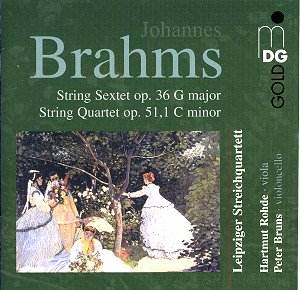
String Sextet No.
2 in G major, op. 36
Brahms actually composed
two works for String Sextet,
Op.18 and Op.36, for an ensemble comprised
of a pair each of violins, violas and
cellos. The Op. 36 Sextet, subtitled
Agathe, uses both rhythm and
musical notation, the notes A-G-A-H-E
(forget the T, the "H" is B natural
in German notation), to evoke the name
of Brahms’ beloved, Agathe von Siebold,
from whom he fled when their marriage
seemed expected and impending. Brahms
felt remorseful. "I have played the
scoundrel toward Agathe," he wrote.
However the composition of the Sextet
proved cathartic for him. Referring
to this composition he said, "I have
emancipated myself from my last love".
Work on the Sextet probably started
some four years before his involvement
with Agathe. It was completed five years
after their break-up although the bulk
of the score seems to have been written
in 1864 and 1865.
The first movement
Allegro non troppo, which opens
in a hushed mysterious mood, contains
the ‘Agathe’ motto as well as a rhythmic
motif at the end of the opening theme
that suggests the syllabic stress of
the name when spoken. This rhythmic
motif can also be found in the second
movement Scherzo, as well as
a lively stomping Ländler-like
Trio section. The third movement Poco
Adagio was described by the renowned
Viennese critic, friend and supporter
of Brahms, Edward Hanslick as "variations
on no theme". However careful listening
will reveal this non-theme's resemblance
to the opening theme of the first movement.
The final movement Poco Allegro alternates
lively and relaxed episodes, fugal passages
and long-lined songs. Emancipation at
last from an unquiet conscience, perhaps?
This is a well controlled
and confident account by the augmented
Leipzig String Quartet who play with
an unmannered intensity. The pensive
and somewhat unsettled mood of the first
movement Allegro is capably communicated
by the players. Also well interpreted
is the pastoral quality of the third
movement Poco Adagio. The anguish
of the dark-hued undercurrents of this
multi-faceted score are better conveyed
on rival versions from the Stuttgart
Soloists on Naxos 8.550436 and the period
instrument ensemble L’Archibudelli on
Sony SBK90477. Both the suggested recordings
are coupled with the Brahms String
Sextet, Op.18 and are available
at super-bargain price.
String Quartet in
C minor, Op. 51 No. 1
The second work on
this release is the four movement String
Quartet in C minor, Op. 51 No. 1.
It is not known exactly when the work
was composed but it is known that the
Hellmesberger Quartet premiered the
score on December 11, 1873 in Vienna.
Perhaps Brahms was
exaggerating when he stated that he
had composed and destroyed twenty other
String quartets prior to the
publication of this C minor Quartet.
Described as a ‘masterwork’
by many critics Brahms uses economy,
structural mastery and an integration
rarely encountered in his early chamber
scores. Brahms’s penchant for weaving
seamless sonata forms is exercised in
the opening Allegro movement
of the C minor String Quartet.
The main theme, built from an agitated,
rising, dotted-rhythm motif, is presented
immediately by the first violin. The
movement is remarkable for its wide
ranging treatment of tonality. The second
movement Romanze is in sonatina
form (sonata without a development section),
and begins with a tender theme in dotted-rhythm
motion which is permitted to grow into
the heartbreaking melancholia of the
second theme. Brahms has created a lyrical
movement which is languid, unsettled
and introspective. Only in the third
movement is the gloom dispelled, where
in place of the expected Scherzo,
Brahms inserts a movement in the
nature of an intermezzo whose central
section mimics the style of the popular
Austrian Ländler. The Allegro
finale returns to the tragic mood of
the first movement. Its principal subject
hints at the themes of both the opening
Allegro and the Romanze,
and launches a movement that is complex
in its formal realization and austere
in its emotional milieu.
In the C minor String
Quartet the Leipzig String Quartet
give a thoughtful, rather measured and
poised interpretation which fails to
reveal the intense heart-searching temperament
of this passionate score. The Belcea
Quartet have recently released an enchanting
and stylish recording of this work which
is superior to this account from the
Leipzig String Quartet. My main recommendation
for this work however is contained on
the complete set of the three Brahms
String quartets together with
the Piano quintet Op.34 from
the Borodin Quartet on Teldec Ultima
8573-87802-2. An amazing buy at super-bargain
price and performed by the Borodins
with appropriate poignancy and marvellous
precision.
The recorded sound
is of the high quality that has come
to be expected from the MDG Gold label.
These are fine accounts by the Leipzig
String Quartet, that will provide much
pleasure.
Michael Cookson



 Leipzig String Quartet