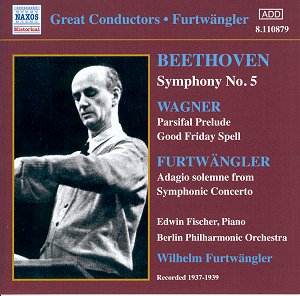
This latest release
in the Naxos ‘Great Conductors’ series
neatly coincided with the 50th
anniversary of Furtwängler’s death
on 30 November 1954.
Understandably, Naxos
give top billing to what I think was
the first of his two studio recordings
for HMV of Beethoven’s Fifth. For some
years I’ve had in my collection his
later recording, made in March 1954
with the Vienna Philharmonic but I hadn’t
heard this earlier traversal before.
In general the 1937 reading is to be
preferred. It’s much more lithe and
urgent where the later version is heavy,
almost portentous by comparison.
On this occasion timings
are instructive, I think. In 1954 Furtwängler
took 35’35", almost a full four
minutes longer than in 1937. That’s
a large difference in a relatively short
work. In the first movement I make the
speed of the basic tempo around 93 bars
to the minute. In 1954 that had broadened
to approx. 87 bars per minute. As a
result the whole movement lasts for
8’33" in the later version, compared
with 7’38" in 1937. That’s not
all. The sound produced by the VPO is
much fuller and bass heavy and I don’t
think that’s simply due to the respective
ages of the recordings. No, in 1937
Furtwängler drives the first movement
along with a relentless, fiery energy
that I don’t find present in 1954.
At the start of the
second movement I thought initially
that Furtwängler’s pace was a bit
too stately (though, once again, he’s
even more measured in 1954). The initial
marking is Andante con moto and
it seems that he’s overlooked the fact
that an andante should be around walking
pace. At this point my inclination was
to prefer, say, Erich Kleiber in his
1953 Concertgebouw reading (Kleiber
takes 9’15" for this movement against
Furtwängler’s 10’12" here.)
But as the movement progressed Furtwängler’s
powerful, serious conception of the
music drew me in further. His is a profoundly
shaped reading of the music which, in
its own terms, is very convincing.
He’s extremely "subjective"
at the start of the third movement,
pulling the speed about significantly.
In Furtwängler’s hands the movement
is full of hushed drama and of tension
worthy of Alfred Hitchcock. The transition
to the finale is masterfully controlled,
with the energy held in check like a
coiled spring. The finale itself is
full of controlled exuberance and I
much prefer this to the substantially
weightier 1954 reading, which by comparison
has too much gravitas and, to my ears,
little genuine joy.
So this 1937 reading
is much to be preferred, I think, to
the later version. Interestingly, I
have another Furtwängler recording
with the BPO. This is a live recording
from June 1943, included in the first
of DG’s two boxes of wartime recordings
(471 289-2.) The interest here lies
in the fact that the 1943 traversal
is in many respects "betwixt and
between" the two recordings discussed
above, and not just in terms of chronology.
The whole performance lasts 33’08"
and, for example, I find the first movement
not to be quite as taut as was the case
in 1937 but the finale is perhaps the
most powerful and strongly projected
of the three (because it was ‘live’?)
I’m aware there are other Furtwängler
recordings of this symphony available
(which I haven’t heard) but these three
seem to offer some indication of his
evolving approach to the work.
This Naxos CD also
includes an example of Furtwängler,
the composer. He made this commercial
recording of the middle movement (only)
of his Symphonic Concerto with Edwin
Fischer in 1939. (I believe this to
be the same performance that’s included
on a (more expensive) Testament CD,
SBT 1170, where the coupling has the
same artists in the Brahms Second Piano
Concerto.) This is only the second piece
of music by Furtwängler that I’ve
heard. Like his Second Symphony I find
that it is rather long-winded for the
material. There’s lots of rumination
from the soloist but the music doesn’t
seem to me to get anywhere in particular,
though there’s no denying the sincerity
of the enterprise. I doubt I shall return
to this recording, especially as the
sound quality is not especially good.
The orchestra is not very well reproduced
and the piano sounds clangy at anything
above mf.
As I said, Naxos give
top billing to the Beethoven but I actually
think the performances that have the
greatest stature of all are the excerpts
from Parsifal. The Good Friday
music is noble and intense, the BPO
playing the long lines demanded both
by composer and conductor with incandescent
intensity. However, it was the performance
of the Prelude to Act One that really
took my breath away. Just the first
few notes convey the spirituality and
spell-binding intensity that are to
be the hallmarks of this performance.
The whole reading is profound and searching.
Furtwängler displays infinite patience
as he lets the music unfold in a timeless
fashion. He is rewarded by elevated,
rapt playing from the BPO. This is a
truly visionary performance which, in
my opinion, is alone worth the price
of the disc.
Here, then is a very
fine example of Furtwängler in
Beethoven and some supreme (and rare)
Wagner performances. The transfers by
Mark Obert-Thorn reproduced well on
my equipment and Ian Julier’s notes
are, as usual, interesting, informative
and convey enthusiasm for the performances
about which he is writing. This disc
offers a good example of why Wilhelm
Furtwängler is regarded by so many
good musical judges as a great conductor.
These are performances that will grace
any collection and I strongly recommend
this disc.
John Quinn
see also review
by Jonathan Woolf



 **Edwin Fischer (piano)