Written
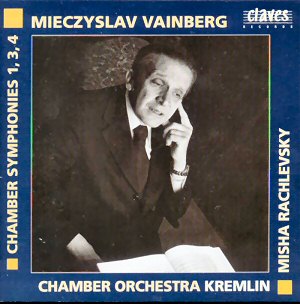
over the last decade of his life the Four Chamber Symphonies don’t
differ very much from Vainberg’s conventional symphonic
statements. That said the Fourth is an oddity inasmuch as it includes
a concertante role for the clarinet. The earliest of them bears
a more than striking procedural similarity with Prokofiev’s
Classical Symphony. In the earlier work’s Allegro
opening - with its four solid classical movements – we can
hear the Prokofiev influence allied to a slight whiff of Elgar’s
Introduction and Allegro in its exhilarating drive. The string
writing is athletic and attractive with glancing Shostakovich
affiliations, not least in the gracefulness and freely moving
simplicity of the Andante. There are moments of shadow; the violins’
unease at the start of the Allegretto for instance which is otherwise
ostensibly untroubled, and that brings with it a certain strain,
a sense of unresolved tension – tangential and quizzically
intense. The gutsy, clearly neo-classical Presto finale is lit
with skittering lines. Alluding to Prokofiev but also with its
own distinctive brand of sometimes brusque pugnacity.
The Third Chamber Symphony is a more expansive
work than the First. It’s nevertheless taut and opens with
quiet dynamics and a Shostakovitch influenced intensity replete
with ambiguous direction. Though the dynamics grow more emphatic
the sense of melancholic intensity remains unchanged. These are
never quite dispelled by a fast second movement that turns fiery
amidst all its more frolicsome moments and they are indeed heightened
and refracted by the core of the work, an Adagio of unremitting
power. We reach back to the chamber symphony’s opening here
but now the material is more direct, more obviously expressive
and unsettled and exuding a powerful introversion. After which
Vainberg leaves us with an Andantino full of baroque inflexions
that act as a kind of quasi-hymnal balm on the stressful material
that still seeps into the movement. The older procedures seem,
in emotional terms, if one talk of such a thing in this work,
to act as succour and there’s a sense of true resolution
at the close.
The Fourth in the series was completed in 1992,
four years before Vainberg’s death. The role of the clarinet
is somewhat puzzling; I referred to it earlier as a kind of concertante
part but that’s not quite it though it covers much of the
primus inter pares position. And yet when there’s
a cadenza in the allegro-moderato section of this one movement
work (split though into four clear parts) it’s for the cello,
not the clarinet. There are sardonic lines for the strings and
in the Adagio we are reminded strongly of the currents that ran
throughout the similar movement in the earlier work. Vainberg
also mines a rather bizarre form of folk tunes – specifically
Jewish, in which role the clarinet is certainly well suited -
which he contrasts against a leisurely-cum-intense string cushion.
The juxtapositions are only heightened by his concluding baroque
cadences.
The recording and the performances are first
class. Gestures are not overdone; a reasonable and responsible
rein is kept on the more quixotic aspects of scoring, instrumentation
and direction. Rachlevsky is a worthy ambassador for this trio
of chamber symphonies, whose idiosyncrasy of utterance and depth
of feeling are worth getting to know.
Jonathan Woolf



 Eugeny Petrov (clarinet)
+
Eugeny Petrov (clarinet)
+











