Op. 90 comes from Schnabel’s
first recording sessions in 1932, at
the age of fifty – he had for long been
reluctant to take the plunge and continued
to find the studios an unnerving experience.
This sonata was – and on the whole still
is – among the less often played ones
of the canon. It has a first movement
which packs in so much contrasted material
in a short space that it is apt to fall
apart in the wrong hands and a second
movement (there are only two) whose
apparent resemblance to a Mendelssohn
Song without Words tends to invite sticky
sentimental interpretations that make
it seem interminable.
Unfortunately, this
first movement is not one of those where,
by adhering to a strict tempo you can
leave the rest to Beethoven; it needs
far more to give up its secrets. Schnabel
understood this as well as any pianist
that came after him and presents the
movement as an inspired fantasy, the
range of mood from driving energy to
withdrawn meditation effortlessly encompassed
in a single framework. And, while Schnabel’s
technique may have been lacking in the
sense of digital dexterity, the speaking
quality of his left-hand counter-melodies
in the second subject reveals a pianistic
command of another kind.
The finale is kept
joyfully on the move, anticipating Schubert
rather than Mendelssohn. Altogether,
a magical performance.
In op. 101, however,
technical problems raise their head.
Not, certainly, in the hymn-like opening
movement (particularly magical in the
becalmed opening to the development
section) or in the deeply expressed
slow introduction to the finale. But
the intended Schumannesque swagger of
the March-Scherzo is fatally undermined
by fistfuls of wrong notes and even
the rhythm suffers. Bar 25 seems to
represent a particular problem for him
since each time it comes round (three
times) he panics, hurries and, quite
frankly, even with the score in front
of me I can’t quite work out what happens.
Large parts of the finale are simply
too snatched at for the listener to
get a clear idea of what the theme actually
is, though against all odds (it’s the
most difficult section) the fugal development
goes rather well. Some may be able to
"listen through" all this
and discover that the performance’s
heart is in the right place but in all
truth many subsequent performances have
also had their heart in the right place
and have been properly played into the
bargain.
With regard to op.
106, controversy raged practically from
the beginning over Schnabel’s decision
to take Beethoven’s metronome marking
of half-note = 138 at something like
its face value. I should like, however,
to start from the Scherzo, where Beethoven’s
dotted half-note = 80 is reduced to
about 69. The slow movement, too, while
continually adjusting the tempo, never
approaches Beethoven’s indicated speed
and is often very much below it. The
finale, while quite fast enough for
its own good, is nevertheless some way
below 144 to the quarter-note. Now,
having in practice admitted that the
other markings are wrong – and I can’t
for the life of me imagine that anyone
ever could play the Scherzo or the Finale
at the indicated speeds, or make music
of the slow movement at 92 to the eighth-note
– does it not follow that that for the
first movement must be wrong in about
the same proportion?
Maybe some technical
wizard could actually bring off the
first movement at this speed; Schnabel’s
hectic mess does not prove that it is
impossible, but he would seem to have
proved beyond all reasonable doubt that
it was impossible for him. And,
as I said, if you’re not going to try
to demonstrate the rightness of the
metronome markings in all the
movements, why be so dogmatic over just
one? I must say that, when I read in
my colleague Patrick Waller’s review
that "I can’t believe that anyone
would now listen to his Hammerklavier
for pleasure in preference to almost
any modern reading" this seemed
so sweeping that I started with a predisposition
in Schnabel’s favour, but I have to
say that Patrick is only too right,
at least as regards three movements
out of four (in fairness, I should also
point out that Colin Clarke took a very
different view). However, if you want
to get to the heart of Beethoven you’ll
have to get this on account of the depth
and inwardness of the slow movement.
I must say the recordings
sound remarkably well for what they
are and at Naxos price the supreme performance
of op. 90, together with the insightful
slow movements elsewhere, makes purchase
infinitely worthwhile.
Christopher Howell



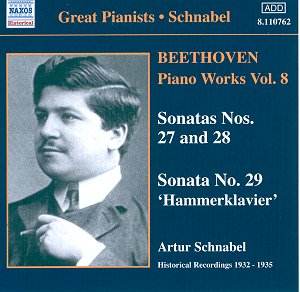
 Artur Schnabel (piano)











