The name of Giacomo Carissimi doesn't appear that often
on concert programmes or on the covers of CD recordings. This
makes it all the more remarkable that within a couple of years
at least five recordings with his music have been released.
It is a shame, on the other hand, that so many of them contain
the same compositions. One of these is the oratorio Jephte,
which appears on three of them, and Jona on two.
Although Carissimi also composed secular works and other
kinds of religious music, it is the oratorios that represent
his main claim to fame. His contribution to the genre is such
that the oratorios by Handel are unthinkable without Carissimi.
Handel knew his oratorios, and borrowed from them.
It is important to understand the goal of the oratorio.
It was a part of the attempts of the Counter-Reformation to
strengthen the faith of the members of the Roman Catholic Church.
The arts played a crucial role in these attempts. It was especially
during Lent that oratorios were performed. The brotherhood of
Santissimo Crocifisso in Rome was in particular active in promoting
oratorio performances. For this brotherhood Carissimi composed
his oratorios. The brotherhood contained people of some social
standing, who gathered during Lent to listen to music and to
a sermon, and stuck to the use of Latin rather than Italian.
This explains the fact that the oratorios all make use of a
Latin text.
Carissimi's oratorios are rooted in the Italian style which
had been developed in the early decades of the 17th century.
In the Historia di Jephte, for instance, Carissimi makes
use of the 'stile concitato' - best known today from Monteverdi's
Combattimento di Tancredi e Clorinda - to depict the
battle of Israel against Ammon. Also very popular at the time
was the 'lament', which appears at several moments in both oratorios.
There is a long lament by Jephta's daughter, when she finds
out that she is going to be sacrificed as a result of her father's
vow to God. In the Historia di Jona it is the prophet
who sings a lament in the belly of the great fish which has
swallowed him after he has been thrown overboard. This lament
is then echoed at the end of the oratorio by the people of Nineveh
when they have heard God's prophecy that he is going to punish
the city for its sins.
Another popular compositional technique was the echo. Carissimi
uses this in the lament of Jephta's daughter, when some of her
words are repeated, like 'ululate' (weep), 'lachrimate' (shed
tears) or 'resonate' (resound). Carissimi also makes use of
the Venetian polychoral technique to illustrate the storm, which
prompts the crew of the ship to throw Jona overboard, and the
calm which results from this.
As the two main compositions on this disc are available
in other recordings, it is difficult to see any justification
for a release like this. And the interpretation by the Carissimi
Consort is just acceptable at best, but more often simply inadequate.
Rhythmic vitality and a clear accentuation of the text are lacking
in the choruses. The solo passages are generally not very well
realised. Whereas some of the basses are too weak at the lower
end of their tessitura, the voice of tenor Fabio Furnari lacks
strength in the upper register. Both as Historicus in Jephta
and in the role of the prophet Jona he gives rather unsatisfying
performances. Soprano Nadia Caristi's voice is too weak and
colourless to realise the crucial part of Jephta's daughter.
Neither the song of praise after the victory over Ammon nor
her lament over her fate make any impact. Her diction isn't
very good either, which is partly due to the fact she can't
pronounce Rs.
I have heard other recordings by this ensemble which I
really enjoyed. But it seems Carissimi's oratorios are just
not within their grasp. I would prefer to hear them in Carissimi's
motets, of which he has written a large number, which have hardly
ever been recorded.
Johan
van Veen
see also Reviews
by Robert Hugill and Kevin
Sutton
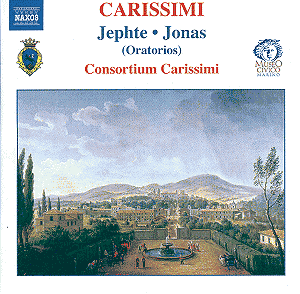
 Consortium Carissimi/Vittorio Zanon











