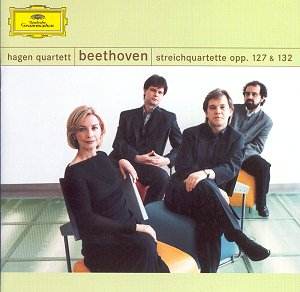
In 1822 Beethoven received a request for three
string quartets from Prince Nicholas Galitsin. The first
of these works, Op. 127 in E flat, was not completed until
1825, the year of the Ninth Symphony. This work has been
well described as 'Beethoven's crowning monument to lyricism'
(Joseph Kerman).
The first movement has a wonderful, lilting
principal theme that dominates the development of the material.
It is introduced by a majestic statement which recurs at
crucial points as the main movement proceeds. The Hagen
Quartet set out their stall in this music, immediately revealing
that their performances will hold abundant interest. The
quality of the sound and of the recording too is first rate,
and the textures are conveyed with the utmost clarity. This
potency informs the music in significant and subtle ways,
and the attention to the detail of the dynamics is another
notable feature of the performances. For this is chamber
music of the utmost refinement which communicates powerfully
too, whenever intensity develops. If this attention to detail
seems worthy of special comment, it is not to suggest that
the approach is mannered. It is simply that the scores contain
such riches that the finest performers can always bring
something special to them.
The Op. 132 Quartet was also commissioned
by Prince Galitsin and completed two years later. The music
typifies Beethoven's achievement in his ‘late quartets’.
For the content is balanced and integrated, but at the same
time extremely varied, allowing the projection of a most
distinctive personality. It is a work of genius which extends
beyond the confines of the classical string quartet’s traditional
procedures.
In truth it is best to consider the first
movement as an exploration of its material, phase by phase,
beginning with the searching and expressive slow introduction.
The pensive atmosphere is broken by a flurry of semiquavers
from the first violin, setting up a passionate and intense
Allegro, and these varying characteristics are projected
fluently, naturally and dramatically by the Hagen Quartet.
The careful articulation of the slow introduction goes out
of its way to communicate the importance of the material
on the larger scale, with subtle changes of note value as
the music proceeds.
The second movement is an equivalent of
the old minuet-and-trio, but the treatment and the playing
have an intensity of vision that transcends that of the
dance.
For all the qualities of the other parts
of the work, the heart of the Op. 132 Quartet lies
in its slow movement. Beethoven gave this music an unequivocal
title: Hymn of Thanksgiving from a Convalescent to the
Deity, in the Lydian Mode. The music therefore has very
personal associations, although it is not in any sense self-pitying.
Two interludes bring the relief of faster tempi from the
prevailing Adagio, and over the first of these Beethoven
wrote the words 'feeling new strength'. This sudden outburst
of joy anticipates the world of the Ninth Symphony, but
perhaps the Hagen performance makes too little of this change
of focus, as though the players are committed above all
to the projection of unity.
That caveat apart, these are performances
to challenge all comers in the catalogue, and with the benefit
of the best modern sound.
Terry
Barfoot