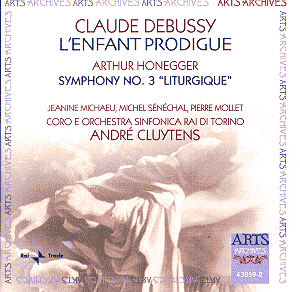
Cluytens was enjoying
considerable renown on disc at around
the time he was taped in Turin. On the
rostrum his career never quite matched
his eminence as a recording conductor
– or that’s how it seems in retrospect
– though by 1960 he was head of the
Belgian National Orchestra. That great
cycle of the Beethoven symphonies he
set down a few years earlier in Berlin
is one of his greatest legacies but
these two dates with the Choir and Orchestra
of RAI, Turin, shows how proficient
he must have been as a guest conductor
and, incidentally, how well drilled
the orchestral and choral forces were.
Students of performance
practice can note, once again, how tempi
have slowed in symphonic works such
as the Honegger. Clearly, if the performances
of Munch, Baudo and Cluytens are anything
to go by performances of Honegger in
the 1950s and early to mid 1960s was
considerably faster than we can expect
nowadays. This is most noticeable in
the great slow movements. The important
point to note is that the symphonic
proportions are properly maintained.
Both Baudo, with the Czech Philharmonic,
and Cluytens, here, take the De Profundis
Clamavi at a forward moving tempo
that seems rather alien to current preoccupations
with expressive anguish; a recent Naxos
recordings, finely played though it
was, took nearly fifteen minutes to
Cluytens’ 11.50 and Baudo’s 12.10. The
uniformity of tempo in the three movements
gives it a far more compact and, in
my view, more cohesive tension when
performed like this, no matter how lavish
or beautiful the sheen when taken to
extremes (i.e. von Karajan).
The Turin orchestra
plays well; the string choirs blend
attractively, sectional discipline is
tight, the brass punch out, the winds
are well balanced. That slow movement
is more austere than we are now used
to and it bears strong similarities
with Baudo’s approach in his Czech cycle
both in tempo and in sonority and colour.
The basses are "tangy" in
their moments of crisis, and solidly
dark hued whilst the lower brass is
blackened. Radiance is hard won, not
Elysian; it emerges through crises and
is not predestined or ordained. As in
all the better performances we feel
a sense of journey, crisis, resolution
and emergence. The finale is strongly
delineated, brisk but relaxing with
acute judgement with a sense of arching
romanticism and urgent drama. All the
transitions are well handled and the
sense of unity at the end is palpable.
Debussy’s early L’Enfant
Prodigue receives an equally persuasive
reading abetted as it is by three idiomatic
voices. Fortunately the balance is once
again pretty good, though not always
consistently – the Turin radio engineers
were on generally good form as were
their orchestral and choral compatriots
– and there’s sufficient air around
the voices. The orchestral patina is
malleable, warm and liquid, the rhythms
are finely sprung in Je m’enfuis
whilst the trio and finale Mon
Coeur receives a genuinely noble
and effective climax.
The text is printed
in French only and there are some good
notes from Alan Sanders. This strikes
me as more than a mere souvenir of Cluytens
– it’s an admirable performance of the
Honegger and a warm one of the Debussy
and it reflects well on Arts to have
released it.
Jonathan Woolf
see also review
by Terry Barfoot



 Choir and Orchestra of RAI, Turin/André
Cluytens
Choir and Orchestra of RAI, Turin/André
Cluytens