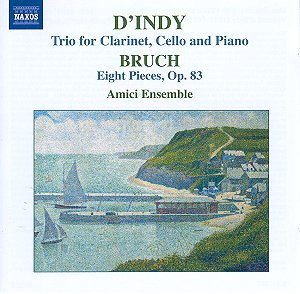
An interesting combination
of instruments here - piano, clarinet and cello - and an equally
interesting pairing of works. This was made possible only because
the Amici players chose Bruch’s own alternative version of his
Acht Triostücke or Eight Trio Pieces Op.83 in which the
cello substitutes for the viola (there is also a version in
which, like Mozart’s Kegelstatt Trio K.498 and Schumann’s
Märchenbilder Op.132, the violin replaces the clarinet).
Bruch responded warmly to the brown or purple colours - my preferred
ones when I hear such rich alto instruments - of the clarinet,
viola, horn or cello. He did not care a whit for the piano,
declaring fairly early on in his career that it was his ambition
to stage a public auto da fè (a ritual burning) of pianos
in a town square. And that’s despite the fact that he was more
than a fine pianist himself, if No.4 of the set is anything
to go by. For a while Bruch’s second son Max Felix was a professional
clarinettist, before going off to the then burgeoning retail
trade in gramophone records (those were the days). It
was for him that he wrote not only Op.83 but also the Double
Concerto for clarinet and viola Op.88 the following year. In
addition there was talk of using the harp instead of the piano
for three of the eight, Nos.3, 5 and 6; one can hear the arpeggiated
shapes of the piano writing that might well have had that instrument
in mind. Back in 1988, when my biography appeared marking the
150th anniversary of Bruch’s birth, the BBC honoured
him as ‘This Week’s Composer’, and enterprisingly agreed to
my suggestion that after Op.83 had been played in a studio recording,
those three numbers were repeated but with harp substituting
for the piano, undoubtedly the first time since 1910. All the
pieces save one are in the minor mode (the scherzotic
No.7 therefore a welcome relief), lending a rather sad and wistful
mood to the music. His love of folksong is clear if only in
one of them, the Rumanian Melody No.5, suggested to him
by Princess zu Wied at one of his open-house Sunday afternoon
musical gatherings in Berlin. It was to her that Bruch dedicated
the set. Apart from a single Piano Quartet written in 1886,
these pieces represent a return to chamber music after his second
string quartet Op.10 way back in 1860. Although Bruch himself
recommended dipping into, rather than playing all eight pieces,
it is hard to avoid doing so, they are so engagingly melodious.
In terms of harmony and overall structure (binary, ternary or
sonata form) not much has changed: Schumann, Mendelssohn and
of course now Brahms are all there, but needless to say there
is no sign of Wagner. Only three years later, but light years
away from the ultra-Romantic Bruch, Stravinsky would scandalise
the musical world in Paris with his Rite of Spring. Extraordinary to realise
that Bruch lived on another seven years, linking Mendelssohn
with Stravinsky. Would that he had begun by writing like the
former, and at the end of his life like the latter.
Another
octogenarian composer was Vincent D’Indy, though Saint-Saëns
(1835-1921) outlived them both by making it to 86. Unlike Bruch’s
Indian Summer trio, D’Indy’s is a much earlier work, written
in 1888 when in his late thirties. Because he played all three
instruments involved, it is well written for them, though ultimately
it was the piano in which the composer excelled, and D’Indy,
unlike Bruch, makes no attempt to avoid the influence of Wagner
though neither man got away from Beethoven. He was late into
his teenage years and intent on a military career (Napoleon
his idol) when he discovered his natural talent for composition.
Befriended by his contemporary Henri Duparc, he studied organ
and composition with César Franck at the Paris Conservatoire.
The trio heard here is the first of his mature works, and already
sounds quite different from Bruch’s, leaving aside national
differences and characteristics between 19th century
French and German music. Franck’s influence on its structural
unity is due to the motivic principle followed throughout. The
second movement divertissement is particularly charming as it
dispenses its Gallic wit.
The
Amici players are highly accomplished technicians and have a
clear rapport with the style of this Romantic music. In Bruch’s
adaptation, cellist David Hetherington has much high writing
to contend with and generally does so with ease. Intonation
in the latter moments of No.5 and some of the exquisitely beautiful
No.6 in Bruch’s Op.83 are worrying due to problems unifying
vibrato between cello and clarinet; probably it would have been
wiser to have dispensed with it altogether. There are similar
moments of concern which seem to have risen from the cutting-room
floor in the opening movement of D’Indy’s work, though Joaquin
Valdepeñas plays its second movement beautifully. The recording
acoustic is generous, and while Valdepeñas brings warm-tone
to his clarinet playing, Patricia Parr is sympathetically discreet
in her role as accompanist yet confident as a virtuoso. This
is a valuable addition to the catalogues and a must either for
collectors of alternative versions or for lovers of Romantic
music in general.
Christopher Fifield



 Amici Ensemble