Discs 23-34
CD23 [62:33]: Harpsichord
Sonatas Nos Kk: 356 in C [6:05]; 357 in C [4:09]; 358 in D [4:07];
359 in D [3:29]; 360 in B flat [4:03]; 361 in B flat [3:00]; 362
in C minor [2:43]; 363 in C minor [3:00]; 364 in F minor [3:38];
365 in F minor [3:28]; 366 in F [4:02]; 367 in F [2:58]; 368 in
A [5:22]; 369 in A [4:45]; 370 in E flat [3:34]; 371 in E flat
[3:27].
This disc contains
eight straight pairs. Kk356 is one of Scarlatti’s most expansive
slower sonatas. It requires an extended upper range with a high
G which few harpsichords of the time would have possessed. Here
Ross changes back to the brighter sounding harpsichord by Anthony
Sidey which he used for the sonatas with Kk Nos 94-188. It is
the final change of instrument in this set. Kk357 is less well-known
and provides a “free-wheeling” contrast. The next two pairs of
sonatas are chipped from the same block with Allegro being
followed by a characteristic Allegrissimo in 3/8. Then
comes a pair in C minor (Kk Nos. 362 and 363) and Scarlatti again
finds some memorable if dark material to grace this key. Two almost
equally dark sonatas follow in F minor and, after a bright start
to Kk366 in F major, this too gravitates to minor keys. Its partner,
Kk367, is a rather tough nut on first hearing with sweeping simultaneous
runs for both hands in opposite directions. The following pair,
Kk Nos. 368 and 369 are particularly striking works. In the former,
each half is in ternary form with a greatly contrasting central
section in the minor. Ross maximises the tonal contrasts and each
time the return to the original material is joyously achieved.
In Kk369 Scarlatti experiments with syncopation and he does so
again, if rather less memorably, in the concluding sonata, Kk371.
CD24 [64:44]: Harpsichord
Sonatas Nos. Kk: 372 in G [2:41]; 373 in G minor [2:52]; 374
in G [3:05]; 375 in G [2:24]; 376 in B minor [3:45]; 377 in
B minor [3:15]; 378 in F [3:50]; 379 in F [2:40]; 380 in E [4:07];
381 in E [3:32]; 382 in A minor [2:58]; 383 in A minor [2:57];
384 in C [3:05]; 385 in C [3:15]; 386 in F minor [3:16]; 387
in F minor [2:37]; 388 in D [4:12]; 389 in D [3:16]; 390 in
G [4:22]; 391 in G [2:28].
The importance of
pairing is so well illustrated at the beginning of this disc.
It is G all the way in the first two pairs. Kk372 is uncomplicated
and bright, and does not stray into the minor at all in the
first half. Scarlatti rectifies that after the double bar and
then follows it up with a sonata marked Presto e fugato
in G minor. Kk374 is a highly-decorated Andante, following
which Scarlatti again finds the right contrast with a brief
and repetitive sonata in 6/8. Kk Nos 376 and 377 are unusual
minor key sonatas in that they spend much time in relative major.
The next pairing is more typical – nominally in a major key
but gravitating to the minor. For Kk379 Scarlatti returns to
his favourite 3/8 time having avoided it since Kk371 – prior
to that it had been a virtually invariable choice for the second
of each pairing for quite some time. Kk380 in E is one of Scarlatti’s
best known sonatas. Marked Andante comodo, Ross adopts
quite a slow tempo and doesn’t repeat the second half. Horowitz,
Pletnev and MacGregor all recorded this on the piano but none
of them gave us its partner Kk381 – a splendid romp (in 3/8
of course!). Kk382 is a tuneful gem with little modulation,
its partner Kk 383 being notably more adventurous. Kk384 is
marked Cantabile andante but quite a bit of the material
would not be easy to sing. Kk Nos. 386 and 387 are amongst Scarlatti’s
most chromatic creations, the former very restless at Presto.
The next pair is more conventional and the final pair typically
bright Scarlatti in G major. In Kk391 (not Kk389 as the documentation
suggests) Ross makes very good use of the lute stop to provide
an echo effect to the many repeated paragraphs.
CD25 [62:31]: Harpsichord
Sonatas Nos. Kk: 392 in B flat [3:35]; 393 in B flat [3:04];
394 in E minor [5:23]; 395 in E [3:44]; 396 in D minor [3:52];
397 in D [3:14]; 398 in C [3:18]; 399 in C [3:16]; 400 in D
[2:14]; 401 in D [3:37]; 402 in E minor [4:36]; 403 in E [3:47];
404 in A [4:03]; 405 in A [3:18]; 406 in C [2:34]; 407 in C
[2:53]; 408 in B minor [2:59]; 409 in B minor [3:00].
After a benign opening,
Kk392 becomes one of Scarlatti’s weirder sounding works; its
partner is a minuet. Kk394 is as “open” as possible with two
passages of completely new material opening the second half.
One of these is the cascade of arpeggios mentioned in the booklet
but, once again Kk389 (an innocent enough creation), wrongly
gets the credit. Kk395 is a much more conventional riposte in
the major and 3/8 time. Kk396 is remarkable in having a 3 bar
opening section in common time following which it switches to
6/8 never to return. Marked merely Andante, only the
first 3 bars are here played at that pace and surely Ross was
right about that. It is paired with Kk397 which is almost a
study in triplets, particularly for the left hand. Then come
some of Scarlatti’s longest leaps - 3 octaves - to open Kk398.
This Andante is paired with Kk399 which is a good example
of how interesting C major can be in the hands of such an imaginative
composer. The next pair is unremarkable but Kk402 is one of
the most imposing slower sonatas and there is no need to repeat
either half. Its partner Kk403 provides the expected contrast
in feeling but unusually shares some of its thematic material.
Kk404 is another extended slower work whereas Kk405 is a merry
dance. The next sonata seems typical enough, despite some tricky
upward runs at the end of the first half. In the same place
in the second half Scarlatti stops his upward C major runs on
B flat to jolt us out of any complacency. The final pair is
well-rooted in B minor. Kk409 is structurally unusual with a
much longer second half achieved through opening with an extended
repetitive passage – no the CD hasn’t got stuck!
CD26 [64:52]:
Harpsichord Sonatas Nos. Kk: 410 in B flat [3:15]; 411 in
B flat [2:14]; 412 in G [3:07]; 413 in G [2:05]; 414 in D
[3:30]; 415 in D [2:36]; 416 in D [3:34]; 417 in D minor [5:03];
418 in F [3:11]; 419 in F [3:34]; 420 in C [3:55]; 421 in
C [4:07]; 422 in C [4:02]; 423 in C [4:20]; 424 in G [3:32];
425 in G [3:39]; 426 in G minor [6:34]; 427 in G [2:36].
The first three
pairs on this disc are rather concise, particularly the second
of each pair. Ross takes Kk410 quite slowly for an Allegro.
Kk411 is a gem despite being very simply structured. It is
notable for prominent counter-directional arpeggios. Kk414
is open with highly contrasting material at the beginning
of the second half. Scarlatti’s transition back to the “recapitulation”
is inspired. Contrary to expectations, Ross doesn’t repeat
the second half. Kk415 is another rather straightforward looking
work on paper but, with more overt interpretation than usual
from Ross, it still exerts a spell. Following that, cobwebs
are blown away in Kk416, a relentless Presto with virtually
continuous semiquavers. Surprisingly, this is paired with
the last (and perhaps the greatest) of Scarlatti’s single
span fugues – Kk417. After an opening reminiscent of the Cat
Fugue (Kk30), Scarlatti effectively doubles the speed
by using semiquavers rather than quavers in the bass. There
is no return to the original but a grand downward repeated
theme takes over in the right hand. Kk418 has some clever
interplay between the hands and is followed by a rather strange
sonata (Kk419) marked Più tosto presto che allegro
and containing several changes of time signature between 3/8
and 3/4. The next pair is vintage Scarlatti - Kk420 arrestingly
martial, its partner Kk421 firmly back in the composer’s favourite
3/8 time. Kk422 opens innocently before taking some unpredictable
turns whilst its partner Kk423 is a study in threes with almost
continuous triplets in 3/8 and at Presto to boot. Ross
takes it all in his stride and delivers amazing precision
here. The final pairing, Kk Nos. 426 and 427 are amongst the
greatest of all the sonatas. The former is a brooding minor
key Andante delivered with great gravity by Ross and,
unusually for a slow sonata, he repeats the second half. The
latter could hardly be more contrasted – to quote the booklet
“railroads of semiquavers” marked as fast as possible. Ross
takes that literally and I can’t imagine it is possible to
play this coherently any faster than it is given here. And
coherent it is too – bravo!
CD27 [68:40]:
Harpsichord Sonatas Nos. Kk: 428 in A [2:14]; 429 in A [3:51];
430 in D [2:34]; 431 in G [0:47]; 432 in G [2:43]; 433 in
G [5;26]; 434 in D minor [3:38]; 435 in D [3:59]; 436 in D
[2:57]; 437 in F [2:45]; 438 in F [3:46]; 439 in B flat [4:09];
440 in B flat [2:29]; 441 in B flat [3:26]; 442 in B flat
[3:04]; 443 in D [4:05]; 444 in D minor [3:28]; 445 in F [3:37];
446 in F [3:26]; 447 in F# minor [2:54]; 448 in F# minor [3:15].
This disc starts
with a pair of sonatas, of which Kk429 is particularly attractive.
Then we have the first singleton for some time, interestingly
marked Non presto, ma a tempo di ballo. This is followed
by two threesomes, the first opening with a very short work
– Kk431 which has just eight bars in each half. This is really
by way of an introduction to two quite substantial works,
the mostly bright Kk432 in which the left hand gets the main
theme, and the gigue-like Kk433. The second triptych of the
disc begins with an Andante in the minor followed by
typical Allegros in common and 3/8 time respectively.
The first of the subsequent pair – Kk437 – is slow and contains
some unusual harmonies but its partner provides maximum contrast.
Next are four sonatas in B flat but the two pairs could hardly
be more different. Kk439 is marked Moderato which is
unusual for Scarlatti and effectively means quite slow. Ross
reveals that this work has hidden depths. It is followed by
a minuet in which the brief first half merely serves an introduction
and is not repeated. Kk Nos. 441 and 442 represent a more
typical pair, the former having the feeling of a dance. Kk443
was the sonata which opened Mikhail Pletnev’s recorded selection.
Never mind the instrument, with Ross’s more forthright approach
I hardly recognised it here. Its coupling is nominally in
D minor but Scarlatti cleverly alternates between minor and
major for almost every phrase, concluding in D major. Kk445
marks a return to Presto and is then offset by a slow
Pastorale in 12/8 (Kk446). There is a rousing pair in the
unusual key of F# minor to finish off the disc on a high note.
CD28 [63:40]: Harpsichord
Sonatas Nos. Kk: 449 in G [3:38]; 450 in G minor [3:05]; 451
in A minor [2:27]; 452 in A [2:54]; 453 in A [2:24]; 454 in
G [4:57]; 455 in G [3:44]; 456 in A [2:13]; 457 in A [3:35];
458 in D [3:49]; 459 in D minor [3:15]; 460 in C [5:00]; 461
in C [3:52]; 462 in F minor [3:21]; 463 in F minor [2:30]; 464
in C [2:24]; 465 in C [3:22]; 466 in F minor [3:47]; 467 in
F minor [3:29].
In so far as Scarlatti’s
work can be divided into periods – there being considerable
uncertainty about what was written when – during this disc we
enter what could be termed his late period. The last 102 sonatas
(from Kk454 onwards) all appear in manuscripts dated 1756, which
was the year before his death and the year Mozart was born.
Before reaching them, the disc opens with two imaginative works
in a major-minor pairing (Kk Nos. 449 and 450) and a rare late
singleton (Kk451). Kk Nos. 452 and 453 is the only pair of sonatas
in the whole canon which both have slow tempo indications. These
sound as if they may be earlier works and they do not appear
at all in Longo’s catalogue. Kk Nos. 454 and 455 is a splendid
pair, the latter of which was recorded by Horowitz (as was Kk466).
The first is marked Andante spiritoso and contains some
greatly contrasted passages. Ross is on the slow side here as
if to emphasise how quick he is in the companion work. This
is simply marked Allegro but rightly taken at maximum
speed. After such a romp, the next pairing seems a little plain
but Kk459 is particularly interesting. Nominally in the minor,
there is a slow introduction in 3/8 before the meat of each
half comes in common time and the major. In the second half,
the introduction is unexpectedly truncated. Kk460 is one of
Scarlatti’s more extended structures and it is clear from his
notes that Ross particularly admired this one. Four of the last
six sonatas on this disc are in F minor, a key in which Scarlatti
often seems inspired. For each of these two pairs the first
work is slow and Kk466 is notably songful and soulful. Of the
faster works, Kk463 is an offbeat creation and Kk467 rousing
and a natural piece with which to conclude a sitting.
CD29 [62:06]: Harpsichord
Sonatas Nos. Kk: 468 in F [3:05]; 469 in F [3:07]; 470 in G
[4:12]; 471 in G [2:22]; 472 in B flat [2:53]; 473 in B flat
[4:10]; 474 in E flat [4:16]; 475 in E flat [3:58]; 476 in G
minor [4:04]; 477 in G [4:00]; 478 in D [3:43]; 479 in D [3:36];
480 in D [4:22]; 481 in F minor [4:22]; 482 in F [3:43]; 483
in F [2:51]; 484 in D [3:05].
The opener, Kk468,
is a slowish Allegro and, in view of its rather extended
nature, Ross sees no need to repeat either half. Its partner
is the perfect foil - a kind of perpetual motion marked Allegro
molto. The second of the next pair, Kk471, is a minuet.
The next two pairs are both slow followed by fast and in Kk474
Ross really makes the harpsichord sing. The following pair is
minor-major although the documentation errs in giving the keys
the wrong way round. Kk475 is notable for a series of three
whole bars of rests near the beginning of the second half giving
the effect of a question being posed (and re-posed). After that
come three sonatas in D but they are not thought to be a triptych
– Kk480 is a probably a singleton. Before that Scarlatti is
again in Andante cantabile mode in Kk478. A true
triptych follows – Kk Nos. 481-3. The first, in F minor, is
slow and profound in feeling. It is followed by two quickies
in the major, the former joyous, the latter imposing and highly
decorated with a Presto marking. The final sonata on
the disc stands alone and simply sparkles.
CD28 [63:40]: Harpsichord
Sonatas Nos. Kk: 449 in G [3:38]; 450 in G minor [3:05]; 451
in A minor [2:27]; 452 in A [2:54]; 453 in A [2:24]; 454 in
G [4:57]; 455 in G [3:44]; 456 in A [2:13]; 457 in A [3:35];
458 in D [3:49]; 459 in D minor [3:15]; 460 in C [5:00]; 461
in C [3:52]; 462 in F minor [3:21]; 463 in F minor [2:30]; 464
in C [2:24]; 465 in C [3:22]; 466 in F minor [3:47]; 467 in
F minor [3:29].
In so far as Scarlatti’s
work can be divided into periods – there being considerable
uncertainty about what was written when – during this disc we
enter what could be termed his late period. The last 102 sonatas
(from Kk454 onwards) all appear in manuscripts dated 1756, which
was the year before his death and the year Mozart was born.
Before reaching them, the disc opens with two imaginative works
in a major-minor pairing (Kk Nos. 449 and 450) and a rare late
singleton (Kk451). Kk Nos. 452 and 453 is the only pair of sonatas
in the whole canon which both have slow tempo indications. These
sound as if they may be earlier works and they do not appear
at all in Longo’s catalogue. Kk Nos. 454 and 455 is a splendid
pair, the latter of which was recorded by Horowitz (as was Kk466).
The first is marked Andante spiritoso and contains some
greatly contrasted passages. Ross is on the slow side here as
if to emphasise how quick he is in the companion work. This
is simply marked Allegro but rightly taken at maximum
speed. After such a romp, the next pairing seems a little plain
but Kk459 is particularly interesting. Nominally in the minor,
there is a slow introduction in 3/8 before the meat of each
half comes in common time and the major. In the second half,
the introduction is unexpectedly truncated. Kk460 is one of
Scarlatti’s more extended structures and it is clear from his
notes that Ross particularly admired this one. Four of the last
six sonatas on this disc are in F minor, a key in which Scarlatti
often seems inspired. For each of these two pairs the first
work is slow and Kk466 is notably songful and soulful. Of the
faster works, Kk463 is an offbeat creation and Kk467 rousing
and a natural piece with which to conclude a sitting.
CD29 [62:06]: Harpsichord
Sonatas Nos. Kk: 468 in F [3:05]; 469 in F [3:07]; 470 in G
[4:12]; 471 in G [2:22]; 472 in B flat [2:53]; 473 in B flat
[4:10]; 474 in E flat [4:16]; 475 in E flat [3:58]; 476 in G
minor [4:04]; 477 in G [4:00]; 478 in D [3:43]; 479 in D [3:36];
480 in D [4:22]; 481 in F minor [4:22]; 482 in F [3:43]; 483
in F [2:51]; 484 in D [3:05].
The opener, Kk468,
is a slowish Allegro and, in view of its rather extended
nature, Ross sees no need to repeat either half. Its partner
is the perfect foil - a kind of perpetual motion marked Allegro
molto. The second of the next pair, Kk471, is a minuet.
The next two pairs are both slow followed by fast and in Kk474
Ross really makes the harpsichord sing. The following pair is
minor-major although the documentation errs in giving the keys
the wrong way round. Kk475 is notable for a series of three
whole bars of rests near the beginning of the second half giving
the effect of a question being posed (and re-posed). After that
come three sonatas in D but they are not thought to be a triptych
– Kk480 is a probably a singleton. Before that Scarlatti is
again in Andante cantabile mode in Kk478. A true
triptych follows – Kk Nos. 481-3. The first, in F minor, is
slow and profound in feeling. It is followed by two quickies
in the major, the former joyous, the latter imposing and highly
decorated with a Presto marking. The final sonata on
the disc stands alone and simply sparkles.
CD30 [61:57]: Harpsichord
Sonatas Nos. Kk: 485 in C [3:43]; 486 in C [3:39]; 487 in C
[3:53]; 488 in B flat [3:26]; 489 in B flat [3:22]; 490 in D
[6:18]; 491 in D [3:45]; 492 in D [3:36]; 493 in G [4:09]; 494
in G [3:49]; 495 in E [2:49]; 496 in E [3:53]; 497 in B minor
[3:30]; 498 in B minor [3:59]; 499 in A [4:07]; 500 in A [3:55].
This disc opens
with a triptych which starts with a slow sonata and concludes
with the ferociously decorated Kk487. This has frequent octave
doublings in the bass and sounds unusual, even by Scarlatti’s
standards. Kk Nos. 490-492 is the last triptych in Kirkpatrick’s
catalogue. All three sonatas were familiar to me from recordings
by pianists but only as single works. They make a marvellous
series, beginning with a work marked merely Cantabile
for which Ross adopts a very deliberate and grand sounding approach.
Kk491 has a memorable “big tune” introduced late in the first
half and Kk492 is a very lively Presto. The triptych
follows what now seems to be Ross’s usual repeat practice: first
half in all and second half sparingly and often only in the
particularly quick works. Kk493 is notable for some very low
bass notes and its partner for straying mostly into the minor
when all those around it are well-rooted in major keys. Eventually,
there is a pair in B minor – Kk Nos. 497 and 498 although the
former spends much time in the relative major. The final pair
in A takes us up to the 500 mark and, in the last sonata, I
wondered if I could hear Ross humming gently to himself.
CD31 [66:28]: Harpsichord
Sonatas Nos. Kk: 501 in C [5:03]; 502 in C [4:20]; 503 in B
flat [2:31]; 504 in B flat [2:37]; 505 in F [2:37]; 506 in F
[2:54]; 507 in E flat [4:07]; 508 in E flat [4:34]; 509 in D
[3:22]; 510 in D minor [3:01]; 511 in D [2:46]; 512 in D [3:15];
513 in C [4:57]; 514 in C [2:16]; 515 in C [3:08]; 516 in D
minor [3;41]; 517 in D minor [3:25]; 518 in F [3:57]; 519 in
F minor [3:51].
In sonata Kk501
Scarlatti uses the marking Allegretto, as far as I can
see for the first time. Subsequently he used this quite frequently,
perhaps as a substitute for Allegrissimo. Kk502 is closed
sonata with changes of time signature in second half. Kk503
is marked in the documentation (and also in Kirkpatrick) as
Allegretto but Ross plays it pretty quickly. Interestingly
Longo, whose manuscript sources may have been different, gives
Allegro for this one. In Kk508 there are improvisatory
passages without bar lines followed by long pauses – another
new departure for the composer. The documentation gives three
of the next four sonatas as being in D minor but it is in error
for Kk Nos. 511 and 512 which are in D major. Although Kk510
opens in the D minor, almost the entire second half is spent
in the major. Kk513 is a Pastorale, unpaired and could perhaps
be regarded as a multi-movement sonata. There is still a central
double bar but the second half is materially unrelated to the
first. The work opens gently in 12/8 and, after an extended
introduction, moves up a gear in the middle of a bar without
a change of time signature. The second half is in 3/8 and has
virtually continuous semiquavers at Presto. The works
from Kk514 onwards are drawn from the last of Scarlatti’s manuscripts
which was dated the year of his death (Longo designated this
sonata number 1!). Kk516 hardly seems to have any melody at
all – its partner is much more attractive and played Prestissimo.
Kk Nos. 518 and 519 both contain some unusual modulations. The
former spends most of its time in A major and minor. Kk519 migrates
to C and finishes in F major.
CD32 [66:01]: Harpsichord
Sonatas Nos. Kk: 520 in G [2:57]; 521 in G [3:49]; 522 in G
[3:00]; 523 in G [2:19]; 524 in F [3:18]; 525 in F [2:39]; 526
in C minor [4:01]; 527 in C [3:10]; 528 in B flat [2:55]; 529
in B flat [2:27]; 530 in E [3:32]; 531 in E [3:32]; 532 in A
minor [3:45]; 533 in A [3:15]; 534 in D [3:29]; 535 in D [3:30];
536 in A [3:44]; 537 in A [3:26]; 538 in G [3:11]; 539 in G
[3:54].
All the remaining
sonatas on the last two discs are pairs. Ross suggests that
the first four works here are studies designed to address particular
technical skills. Then come two fairly quirky sounding sonatas
before Scarlatti hit top form again with Kk Nos. 526 and 527
- another case of C minor bringing out the best in him. The
second of the pair is in the major but the second half opens
with a telling return to the minor. The composer’s markings
are notably changing in these later works. After so many non-specific
Allegros these two sonatas are marked Allegro comodo
and Allegro assai respectively – neither of which I can
recall seeing previously in his work. The next two pairs are
also vintage Scarlatti and bubbling Ross, Kk531 hardly recognisable
here to one familiar with Horowitz’s rendition on the piano.
Kk532 returns to A minor and 3/8 (a time signature which is
relatively unusual for the first of a pair) in a work with ferocious
technical difficulties; its major-keyed partner is mostly sweetness
and light. Kk534 is a slow singing sonata and Ross springs a
surprise with a rare repeat of the second half for this type
of piece. Normally it is possible to tell whether is going to
do so beforehand but here the concluding simple sustained breve
led me to think he had finished. This time the sidekick (Kk535)
strays a little further from the home key but remains joyous.
The following pair is Cantabile followed by Prestissimo
and luminous throughout. Kk Nos. 538 and 539 provide a sturdier
conclusion to the disc.
CD33 [60:40]: Harpsichord
Sonatas Nos. Kk: 540 in F [3:23]; 541 in F [3:55]; 542 in F
[3:48]; 543 in F [3:48]; 544 in B flat [3:15]; 545 in B flat
[3:06]; 546 in G minor [3:54]; 547 in G [4:41]; 548 in C [4:07];
549 in C [4:13]; 550 in B flat [3:34]; 551 in B flat [4:08];
552 in D minor [3:23]; 553 in D minor [4:31]; 554 in F [3;16];
555 in F minor [3:32].
Having apparently
discovered the term Allegretto only after having written
about 500 sonatas, Scarlatti used it often in these last works
– seven of the sixteen on this disc are so marked. The first
pair seems to be unique in that both have this tempo marking.
Kk542 does so too but with the fourth of the disc, Kk543, it
is back to Allegro and some notably imaginative modulations.
The next two pairs have glorious openers marked Cantabile
and the ornamentation in Kk544 is particularly attractive. Kk545
is the last of the Prestissimos, a marking that Scarlatti
used sparingly but tellingly. At breakneck speed, Ross keeps
control admirably here. Kk548 is rather regal, its partner plain
by comparison. Kk Nos. 550 and 551 make a good pair – a tuneful
opener followed by some spicy dissonances. The next pairing
is one of the finest of all, and both are in the minor. Kk552
is clearly binary within each half and the second part of each
half reverts to D major. Kk553 is more constantly dark but there
are central major interludes in each half with some surprising
modulations second time round. So to the final pair which Ross
sees as harking back to the very beginning and “completing a
circle”. The opener is in the major but Scarlatti concludes
his series with a marvellous jig in F minor. It is surprising
that this very last work is not better known.
CD34 [45:48]: Sonatas Nos. Kk: 81 in E minor*
- Grave [1:40] Allegro [3:22] Grave [1:14]
Allegro [1:34]; 88 in G minor - Grave [2:03] Andante
moderato [2:13] Allegro [1:30] Minuet [0:57];
89 in D minor* - Allegro [3:38] Grave [1:01] Allegro
[2:00]; 90 in D minor - Grave [2:46] Allegro [4:24]
without tempo designation [0:58] Allegro [0:56];
91 in G - Grave [1:22] Allegro [3:14] Grave
[1:00] Allegro [1:51] Scott Ross (harpsichord), Monica
Huggett (violin), Christopher Coin (cello), *Michael Henry (oboe),
*Marc Vallon (bassoon). Sonatas Nos Kk: 287 in D [1:37]; 288 in
D [2:10]; 328 in G [3:59] Scott Ross (organ).
This disc brings together all Scarlatti's sonatas
which are not for solo harpsichord. Kk Nos. 81 and 88-91 are multi-movement
works written out as a melodic line accompanies by a figured bass.
Although clearly not intended for keyboard alone, the instrumentation
was not specified by Scarlatti and, as for Bach's Art of Fugue,
it is up to the performers to decide on that. In all of these
works a violin and cello are added to the harpsichord and, additionally,
an oboe and bassoon for Kk Nos. 81 and 89. In the latter sonatas
the oboe is given the lion's share of the melodic line. These
choices seem to work well. I should also mention that there is
a change of harpsichord after Kk81 from the Italian style instrument
used almost exclusively since the Essercizi to a French
style double-manual made by David Ley which Ross used only for
Kk Nos. 31 and 88-91.
Kirkpatrick thinks that these works probably
predate the Essercizi although he based his ordering on
sources rather than stylistic considerations. Structurally there
is variation within these five sonatas, although four movements
are standard except for Kk89 which has three. The slow-fast-slow-fast
model occurs twice - in the first and last of them but Kk88 surprises
by ending with a minuet and Kk90 has a movement without tempo
designation which is definitely not a case of Scarlatti just omitting
to write Grave - at least not in the hands of these players
who play it as an Allegro. There is much fine playing in
these five works but the music is not particularly characteristic
of Scarlatti - they may have been influenced by Handel in particular.
Perhaps Kk90 is an exception in that respect, at least to my ears
it is the most interesting of the works.
To finish there are three single movement sonatas
for chamber organ that were probably written later. The first
two seem to be a related pair. Ross played these on the organ
of the church at Saint Guilhem-le-Désert.
Patrick C Waller
Internal Links
Introduction
Discs 1-11
Discs 12-22
Conclusions
External links
Sale of complete set:
AmazonUK
AmazonUS
Sale of single disc sampler:
AmazonUK
£8.99
Sale of Kirkpatrick’s book:
AmazonUK
AmazonUSA
John Sankey’s MIDI files:
http://www.midiworld.com/scarlatti.htm
Sonatas listed by Kk, L and P numbers:
http://www.classical.net/music/composer/works/scarlattid
Richard Lester's complete set:
http://www.the-scarlatti-experience.fsnet.co.uk/indexb.htm



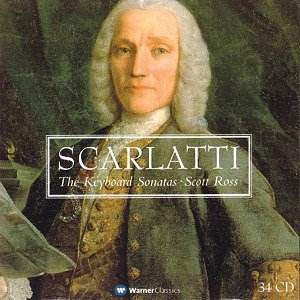
 Scott Ross (harpsichord)












