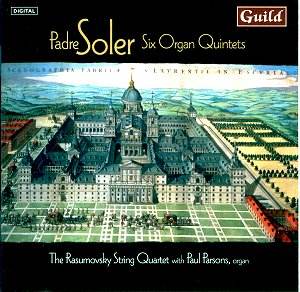
Padre Antonio Soler is best known for his Six Concertos
for two organs, of which several recordings have been made,
and the astonishing Fandango for harpsichord. The pieces featured
on this recording are the only music I know of scored for string
quartet and organ, and were discovered by the late American
organist, Donald Joyce. They were possibly written for the son
of the Spanish King Ferdinand VI, who was a student of Soler
and for whom the concertos for two organs had certainly been
composed.
Soler's style is a unique interpretation of the Gallant
world of composition, encompassing earlier models and Spanish
folksong-related ideas. The forms of the quintets are very irregular;
between three and six movements, with many of the movements
subdivided into further small sections. The sixth quintet as
an example consists of three movements, the first of which is
divided into five smaller sections, but the finale of which
is an unbroken 21 minute rondo with variations. The organ features
in a variety of ways, seldom as a solo instrument in the sense
of a concerto, nor as a continuo instrument, but as an equal
member of the ensemble. The quality of the music is predictably
variable but the concept is refreshingly different. This is
the first recording.
The organ chosen is a beautiful sounding Goetze and Gwynn
copy of a chamber organ by Thomas Parker dating from the mid-18th
century. It may seem a strange choice but, as is pointed out
in the booklet, such organs shared many similarities with Spanish
instruments of the same period, most notably the soft, stringy
Principals and brighter upperwork. The extended bass compass
is also essential. Parsons additionally makes use of a slightly
ill-sounding regal when called for by Soler.
Given the effort to have playing scores created, the
obvious enthusiasm by the performers to have the music recorded,
and the planning and thought that has gone into the whole project,
it is with some regret that I cannot recommend this recording.
The main problem is one of tuning. Organ builder Martin Goetze
informs me that he thinks the 'Parker' organ was tuned in Barnes
'Bach' temperament for the recording, and the contrast between
the many pure thirds in the organ and the much wider thirds
played by the quartet creates an uncomfortable incongruity from
the outset. In addition, the Rasumovsky Quartet play on gut
strings and with Classical bows, but don't convince me that
they have enough experience in this area; intonation and tone
quality are constantly compromised. It is possible to make beautiful
sounds on gut strings too! The biographical note on the quartet
acknowledges that playing such music in this manner is only
one of their large variety of activities and the lack of specialisation
is regrettably evident. While the recording quality is very
fine, I would have preferred a slightly larger acoustic (the
organ is mobile and was on loan from Leeds University for the
recording) to give the sound more bloom, as would have been
the case at the Royal Monastery at El Escorial where these pieces
may have been originally performed. On the positive side, all
the performances seem well paced, and Paul Parsons plays well
throughout, especially as I understand he had to cope with pipes
being re-tuned to play notes outwith the treble compass (top
d# re-tuned to g and top c# to f, the 'Parker' organ going only
to e) and having to add stop changes during pieces in order
to play certain passages an octave lower.
A nice idea then, but not a wholly satisfactory result.
Chris
Bragg