In the early 1960s,
when he was barely thirty, Penderecki
burst onto the musical scene with a
handful of startlingly novel works that
had a considerable impact. His powerfully
impressive Threnody for the Victims
of Hiroshima (1961), an earth-shaking
study in unusual string sonorities,
was encored at its first performance
at the request of the reputedly conservative
audience of the Concertgebouw in Amsterdam.
This says much for the work’s power
to move, for all its technical novelty
and complexity. Penderecki’s groundbreaking
period culminated in the St Luke
Passion (1964). This remains
one of his most popular works to this
day. However, the attentive listener
must have noted that some eclecticism
was already making its way into the
music and in that of his first opera,
The Devils of Loudun.
In the next decade, he went on writing
large-scale works such as Utrenja,
Kosmogonia or Dies
Irae in much the same
vein. Then, he took a stylistic U-turn
that still puzzles some of his staunchest
supporters. This happened with the Brucknerian
Second Symphony, the so-called Christmas
Symphony completed in 1980. I am
still unable to say whether this drastic
stylistic re-orientation was the result
of Penderecki’s will to make his music
more accessible or of a deliberate money-making
marketing process. This does not mean
that all his later works up to the present
day are worthless. As far as I am concerned,
Penderecki’s sincerity is not in doubt;
but I have the impression that he may
now be writing down to his intended
audience, and quite prolifically too.
This is sometimes at the expense of
more profound music-making. The works
of Lutosławski
strongly demonstrated – and still do
– that progressive and imaginative music
could also be beautiful and accessible.
Sorry for this rather
long digression, and now back to A
Polish Requiem. This work had
a long and complicated genesis. It was
eventually assembled from works written
on various occasions between 1980 and
1984. It all started with the Lacrimosa
written in 1980 for Lech Walesa and
the trade union Solidarity in memory
of workers who died during confrontations
with the authorities previously. Then
came the Agnus Dei written in
1981 as a memorial tribute to Cardinal
Wyszynski. The Recordare was
composed to mark the beatification of
Father Maximilian Kolbe. The Dies
Irae followed in 1984 to mark the
fortieth anniversary of the Warsaw uprising.
Incidentally this should not be confused
with the Dies Irae "in
memory of the victims of Auschwitz"
of 1967. The work, as it then stood,
was first performed by Rostropovich
in 1984. The Sanctus was added
in 1993. But since Penderecki’s musical
language did not undergo any further
drastic stylistic changes, A Polish
Requiem did not result in the
patchwork piece that one might have
expected. Stylistically speaking, it
is remarkably coherent, even if no longer
innovative. Penderecki knows how to
handle large choral-orchestral forces,
and how to develop long paragraphs and
build up to well-calculated climaxes,
while drawing on a large stylistic palette.
A Polish Requiem may not
be without "longueurs", but
it nevertheless contains many powerful
moments that cannot fail to impress.
Again, I do not question Penderecki’s
sincerity, even if I admit to being
puzzled by his stylistic re-orientation
of thirty years ago; an unresolved enigma
to the present writer.
The present performance
conducted by the ever-faithful Antoni
Wit is as fine and assured as one may
wish. He draws committed and convincing
singing and playing from all concerned,
to make the best of this substantial
work. As such, and at Naxos’s bargain
price, this release is strongly recommended.
Hubert Culot



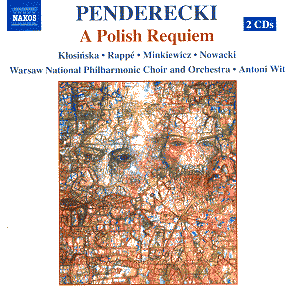
 Izabella Klosínska (soprano); Jadwiga Rappé
(alto); Ryszard Minkiewicz (tenor); Piotr Nowacki
(bass); Warsaw National Philharmonic Choir; Warsaw
National Philharmonic Orchestra/Antoni Wit
Izabella Klosínska (soprano); Jadwiga Rappé
(alto); Ryszard Minkiewicz (tenor); Piotr Nowacki
(bass); Warsaw National Philharmonic Choir; Warsaw
National Philharmonic Orchestra/Antoni Wit