Piazzolla and tango
- without the bandoneon? Without that
most quintessential of tango instruments
how could that be? No problem apparently.
Knowing that bandoneon players are very
hard to find in England, El Ultimo Tango’s
bassist, Mark Goodchild, who has impressive
arranging skills, came up with the idea
of combining flute and saxophone to
recreate the bandoneon timbre with the
added advantage of creating new colours
too. El Ultimo Tango, a small group
of mainly City of Birmingham Symphony
Orchestra players, was formed to specialise
in Argentinian music and the music of
Astor Piazzolla in particular. Cellist,
Eduardo Vassallo has personal memories
of Piazzolla, and his father played
with the composer in Buenos Aires.
El Ultimo Tango clearly
greatly empathise with Piazzolla’s vibrant,
fiery tango music. They play with passion
and joie de vivre. There is a
feeling of freshness and spontaneity
about it all – the frequent glissandos
are witty or bitingly sardonic. The
opening Libertango’s feeling
of wild sensual abandon is palpable,
the music sparkles, lifts the spirits.
Then in Decarissimo, the piano
sets an initial mood of languor, dreaming
sultrily before the flute pushes the
music into faster, perky rhythms, the
ensemble embellishing the material and
the saxophone playing blues. Preludio
is a dirge, the music raw and anguished,
darkly funereal. Bragatissimo’s solo
cello opening with treading bass ostinato
sustains a melancholy mood for much
of its length before the tempo quickens
and the music coarsens and grows increasingly
angry and defiant. Buenos Aires Hora
Cero is sardonic and brutal, suggestive
perhaps of sexual cruelty or of drug-driven
exhaustion, the glissandi sound particularly
menacing. Lunfardo is more vivacious
and uninhibited with some extraordinarily
wild punctuations until the cello introduces
a waltz rhythm to establish order and
sensitivity.
Best known perhaps,
is Adios Nonino The piano meanders
beguilingly, its arpeggios and ripples
very impressionistic, very Debussy-like,
the mood eldritch and sylvan before
the famous melody enters quietly, growing
in fervour. The theme is then taken
up by the cello, then the flute and
saxophone before variations turn classical
forms to jazz and tango rhythms.
But for me the highlight
of this disc is unquestionably Oblivion
scored for cello and piano only. Its
beauty haunts. Once again the opening
piano solo is quite impressionistic
with a hint of Rachmaninov, a hint that
is broadened by the cello’s song. The
tango rhythm is there but muted and
sweetened. This lovely track is worth
the price of the CD alone.
The concert ends with
Piazzolla’s four-movement tango suite
Four Seasons: Spring, bouncy
and energetic and full of zip and colour
but with melancholy cello and wistful
flute episodes seemingly indicating
Spring it is over all too soon while
‘Summer’ suggests languid, drooping
days and there is a touch of the blues.
‘Autumn’ sounds a note of loss and regret
but the season of mellow fruitfulness
also has wilder fruitier jazz moments.
Finally ‘Winter’ is initially hesitant
and cool, then briefly passionate before
jagged tango rhythms are smoothed to
dreamy romanticism as the movement ends,
surprisingly, in classical baroque purity.
The booklet notes are
informative about the players and the
origins and character of the tango but
there is very little or no detail about
the music
El Ultimo Tango presents
Piazzolla sans bandoneon but
with added colour. Tango music played
with fervour and sensitivity. And for
sheer bliss taste Oblivion -
would that it be like this.
Ian Lace



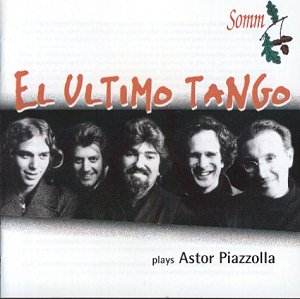
 El Ultimo Tango: Nicolas Bricht (flute);
Mark O’Brien (saxophones); Eduardo Vassallo
(cello); Fred Lezama Thomas (piano) and Mark
Goodchild (double bass)
El Ultimo Tango: Nicolas Bricht (flute);
Mark O’Brien (saxophones); Eduardo Vassallo
(cello); Fred Lezama Thomas (piano) and Mark
Goodchild (double bass) 











