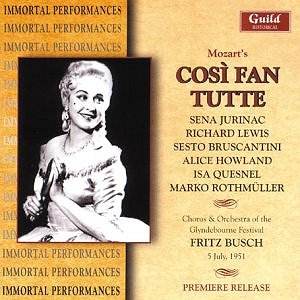
The emergence of the
LP in the early 1950s produced a quite
massive explosion in the issue of complete
operas on record. Not only were twenty
or more 78-rpm discs reduced to five
or six, but also with lightweight pickups
one didn’t have to sharpen or change
the needle between sides either. Currently,
as the original LPs come out of copyright,
many of those recordings are now available
to us on CD at bargain price. Further,
as a consequence of the development
of audio technology and the CD they
can be enjoyed in far superior sound
than could be experienced with the original
LPs. The mad recording scramble of that
period often involved contracting artists
exclusively and plundering festivals
for rehearsed productions, often recording
live performances. In this scramble,
together with the specific requirements
of those exclusively contracted artists,
particularly conductors, some ‘should
have’ recording opportunities were missed.
Glyndebourne had been the basis of several
seminal Mozart recordings before 1939
where Ebert and Busch had developed
an ensemble of true quality. On Busch’s
return to Glyndebourne in 1951, performances
of Cosi were scheduled. Contemporary
commentators enthused about his conducting
and the singing, and the delectable
appearance, of the Yugoslav soprano
Sena Jurinac (b. 1921) as Fiordiligi.
No commercial recordings were made of
the performances although a highlights
disc was recorded involving Jurinac
along with Richard Lewis and the Glyndebourne
Chorus under Busch. It has taken super
sleuth Richard Caniell thirty years
to track down any preservation of the
performances. In the booklet, he recounts
(pp. 21-22) how he located two such
preservations within months of each
other, albeit with many defects and
in relatively poor sound. Using what
he calls artistic licence Caniell has
utilised the highlights disc and the
1935 Glyndebourne recording to patch
in parts of this performance where the
sources were too damaged to use. I explain
this in some detail, as I know some
purists find the practice less acceptable
than I do.
Has the wait and work
been worthwhile, and does the performance
live up to its reputation heard by ears
that have heard many Cosi recordings
since? Certainly the conducting of Busch
confirms his reputation in this opera.
Just three months before his death from
a heart ailment, on 14 September 1951,
he conducts the work with a vitality
and elegance that is most appealing.
In Sena Jurinac he had one of the finest
Mozart singers of the day. Her beautifully
supported tone, fine diction and elegant
phrasing can be heard throughout in
the many ensembles and particularly
in Fiordiligi’s two great solos, the
aria Come scoglio (CD 1 tr. 27)
and the rondo Per pieta, (CD
2 tr. 12). The colour of her voice throughout
its range is formidable considerably
abetting her characterisation and the
performance takes on an added vibrancy
when she is involved. That is not to
imply that others in the cast do not
play a full part in making the performance
the success so widely recognised. Richard
Lewis (1914-1990) starts a little huskily
but is soon into his elegant stride
as Ferrando. In the heady sensitivity
of his singing and phrasing he is ideally
matched by the Guglielmo of Marko Rothmüller.
Their contribution to the many ensembles
is a delight. Although Alice Howland
as Dorabella is no match for Sena Jurinac
in their duets in terms of beauty of
tone or phrasing she does convey the
role’s more flirty character. The two
schemers, Despina sung by Isa Quesnel
and Don Alfonso by Sesto Bruscantini,
are less attractively matched vocally,
although both characterise well. This
is possibly due to my perception of
Bruscantini’s heavy tones and rather
biting phrasing. He commands rather
than persuades.
As to whether there
are enough positives to make for an
outright buy recommendation this will
depend on individual response to the
very variable sound. On some tracks
the hiss is intrusive, in others there
are extraneous noises (CD 2 tr. 15),
whilst in the finale to act 1 (CD 1
tr. 35) the sound breaks up. As always
Richard Caniell is fully honest as regards
the doctoring and interpolations from
other sources he has had to carry out
(booklet pp. 21-22). Despite these factors
and the constricted sound, somewhat
recessed, this is a recording that can
be listened to without too much difficulty.
If you listen through the sonic restrictions
I suggest the singing and overall vitality
of the performance will give much pleasure.
There are not many better renderings
of Per pieta on disc. That is
to quote just one example of Jurinac’s
consummate portrayal which, together
with Busch’s conducting, makes this
performance one of those frustrating
examples where record company martinets
of fifty years ago couldn’t recognise
quality product when it stared them
in the face and was there for all to
hear.
This is an issue collectors
and opera lovers should set alongside
whichever favourite versions currently
grace their shelves. It will not shame
its neighbours.
Robert J. Farr



 Glyndebourne Festival Chorus