This isn’t the first
time Bell has recorded the Tchaikovsky.
He set it down in Cleveland for Decca
with Ashkenazy conducting but like a
good number of others – Vadim Repin
most prominently of late – he returned
to it again fairly soon. This reading
is more personalised than the earlier
one and the gestures are more extreme
and the point of view far more pronounced.
The breathless notes read as if they
were written by a love-sick schoolgirl
but do report Bell as saying that he
finds the work one of the most "intimate"
in the repertory; that, I think, sets
the marker for his performance.
Doubtless there are
slower performances of the first movement
but I’ve yet to hear one. Not even Nigel
Kennedy was this slow, with Bell stretching
the material to a full nineteen and
a half minutes. This in itself is not
the issue – tempo relation is the structural
point – but it becomes an issue if counter-themes
and subsidiary orchestral material is
rendered diffuse or turgid, or loses
its point. This, I have to say, it comes
close to doing in this performance.
The approach is one of corporate reverence
and remarkable attention to detail but
the means sound to my ears somewhat
manicured. In attempting to rid the
work of its bardic heroism, its flag-waving
virtuosic pose, I fear that Bell and
Tilson Thomas have substituted, in this
movement at least, self-conscious mannerism.
Too much here is point making – dynamics
are exaggerated, the melodic lines are
stretched to breaking point, the elements
of innocence they seek are subsumed
instead to a kind of didacticism; the
cadenza is rather sentimentalised and
Bell, though evoking intimacy in his
reported comments, can’t convert it
into simplicity. Too much here is fussed
over, presented as new minted and stretched.
Tilson Thomas can’t help camping up
the percussion at the end either.
The slow movement is
taken at a central, reasonable tempo.
He brings a greater weight of expression
here than before. The principal flautist
shines as well, shadowing the solo lines.
Bell dares a couple of tiny, quick portamenti,
though he can’t resist going all out
for extremes of dynamics even here.
The finale is taken at a relaxed tempo;
it’s playful but with a lot of contrasts.
A genuine highlight is the way Bell
matches his phrasing and tonal shading
with the wind principals – not for nothing
is he an increasingly eloquent chamber
player. The quality he demonstrates
uppermost here is that of involvement
with those around him; to that extent
he’s an active collaborator and not
just a hired gun. And his tone takes
on greater qualities of depth here.
He was disappointingly monochromatic
in the first movement. And yet even
here things sound capricious for the
sake of it ... even if they’re not.
Things don’t sound natural; it’s all
too stop-start. And to be truthful,
not too exciting either. And in the
finale of this of all concertos that’s
a downright sin.
Still, the audience
in Berlin whoop with delight so what
do I know. The ungenerous extras were
recorded in the Philharmonie as well
but aren’t live. The recording throughout
is supple and warm and the orchestra
plays with finesse and sound well rehearsed.
The Meditation is attractively playful
and expressive. But at fifty-one minutes
for a major work such as this I’m disappointed
that Bell didn’t get down to the library
and dust off, say, the Taneyev Suite
de Concert or a work of that vintage.
As for the Concerto you’ll find it something
of a novel experience but as for me
I’m off to listen to Heifetz, Milstein,
Oistrakh and Elman.
Jonathan Woolf



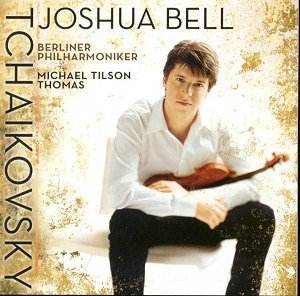
 Joshua Bell (violin)
  SONY
CLASSICAL SUPER AUDIO SH 94829 [51.01]
SONY
CLASSICAL SUPER AUDIO SH 94829 [51.01] 











