Often a single adjective
will attach itself unbidden to the artists
who cross our path and then resurface,
Pavlov-like, every time the name is
mentioned. In Lucia Popp’s case the
adjective was "lovely". She
was a "lovely" singer. We
can hear at once in the Schubert group
her unfailingly golden tone, always
rich though not especially "big",
and her warm personality pours into
our sitting-rooms. In the Strauss group
her voice expands and soars as a true
Strauss soprano’s should; she is beautifully
tender in Meinem Kinde, deeply
stirring (and not just noisy) in Allerseelen,
and we can judge her communicativeness
by the spontaneous applause (from a
non-German audience) which greets the
humorous Hat gesagt. Her "loveliness"
is a boon to the Schoenberg group, rising
to an ecstatic performance of Waldsonne,
one of the few actually "lovely"
pieces he ever managed to write.
Yet a few points have
to be made. If we compare her Der
Jüngling an der Quelle with
the studio version by Edith Wiens (on
CBC) we are held spellbound by a tighter
control over line in the latter which
is surely an essential in Lieder singing;
Popp is more generalized in her expression.
On the other hand, while we might begin
by preferring Wiens’s Der Einsame
for the same reason, this is a longer
song and about halfway through we become
aware of a certain reined-in quality
in Wiens which loses our attention while
Popp’s bigger gestures are increasingly
engaging us. To be absolutely fair we
should compare studio performances with
studio performances, live with live;
but Popp’s name became something of
a household word while Wiens, much though
she was/is appreciated especially by
musicians, didn’t quite, and these discs
seem to suggest that the public’s judgement
was about right.
Another point is that,
however polyglot singers may be, the
language of their infancy nevertheless
stirs some basic, as it were inherited,
emotion within them. The public almost
forgot that Popp was from Slovakia (we
expect singers from those parts to have
long and unpronounceable names), but
Bratislava was her home town and Slovak
(which is very close to Czech) was presumably
her first language,
the language of her first affections,
however much she felt at home in German.
And so it is that in the Dvořák
group she goes beyond loveliness to
touch a deeper chord. If we have listened
so far with a smile of appreciation,
I at least felt a lump in my
throat as she began these songs, which
are assuredly very beautiful in any
case – indeed, I can’t understand why
the first has not become as popular
as the so-called "Songs my mother
taught me". On the other hand,
though the cycle is rare this was not
my first encounter with it nor even
my first recording of it and it had
never affected me this way before, so
I think we must here declare a truly
great performance from Popp which reveals
an underestimated set of songs in all
its beauty.
Back to "loveliness",
I’d say, for the rest of the programme,
though I note a tighter control over
line in these 1980 tracks. Is this the
way Popp’s art developed between 1980
and 1983? Does the slightly more distant
1980 recording (though in the same venue)
just make it sound that way? Did Geoffrey
Parsons inspire a more detailed approach
while Irwin Gage stimulated her to a
broader brush? I should need to assemble
more Popp recordings, both studio and
live, to answer this – and I am sure
it would be an enriching and pleasurable
experience.
The booklet contains
an appreciation of the singer by Alan
Blyth who, in the role of critic, has
elsewhere been among the first to condemn
IMG’s reprehensible policy throughout
the BBC Legends series of not providing
texts and translations. They tell us
these can be found on their website,
which was not true at the time of writing
(23rd June 2004) though I suppose they’ll
be posted sooner or later. Had they
troubled to print them, they might even
have noticed that Brahms’s Sehnsucht
is not op.49/3, as stated, but the composer’s
other song of the same title (but different
words), op.14/8.
All
the same, the record as a whole is recommended
to all who treasure lovely singing;
the Dvořák group is essential for
collectors of great singing.
Christopher Howell



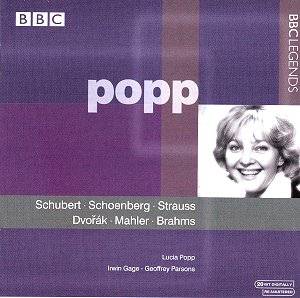
 Lucia Popp (soprano), Irwin Gage (piano –
Schubert, Schoenberg, Strauss), Geoffrey Parsons
(piano – other items)
Lucia Popp (soprano), Irwin Gage (piano –
Schubert, Schoenberg, Strauss), Geoffrey Parsons
(piano – other items)