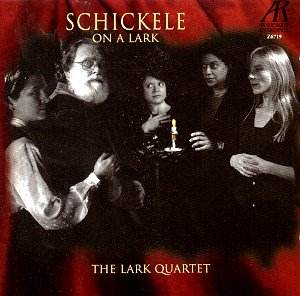
Schickele on a Lark
is a play on the name of the String
Quartet with which he has been associated.
That same quartet has distinguished
itself in the American repertoire (vide
their Amy
Beach on Arabesque). Also one assumes,
given Schickele’s predilection for humour,
that this is also a reference to being
‘on a lark’, as in jesting. But this
is Schickele not P.D.Q. Bach, a name
by which he has been known to go. He
shows, not for the first time, a well-developed
sense of colour and affinities in this
charming collection of chamber works.
His Sextet shows a
distinctly Graingeresque attitude to
markings and tempos (Slow, Still is
the third movement of this six-movement
work and the fifth is marked Easy-Going
Waltz Tempo). This is a colourful and
rhythmically alive Sextet with tinges
of minimalism as well as countrified
dancery. It’s perhaps more a suite than
a sextet but perhaps it’s the composer’s
prerogative to call it what he wants.
The Quintet owes at least some of its
inspiration to Brahms, whose similar
work in F minor is one of Schickele’s
favourites. He plays what he modestly
calls a composer’s piano and it’s certainly
true that the Brahmsian inheritance
is filtered most clearly in the opening
movement, which is relatively dense
for Schickele. Elsewhere we meet more
of those unmistakable directions (Flowing-A
Bit Faster, Slow, Serene and Lively)
and plenty of bravura boogie in the
second movement (a Scherzo) which is
full of pizzicati and drive, a real
foot-tapper, complete with an old time
dancing sequence (a sort of Schickeled
Waltz) with imitation of what he calls
‘Celtic fiddle’. Again, who am I to
argue with him but surely he’s been
eating Cajun here, not Celtic. Well
he calls it Celtic, I calls it Cajun
but one thing’s for sure – there’s a
delicious imitation fiddle and accordion
duet somewhere along the line. The slow
movement is a touch mordant with a xylophone
imitation (that’s what it sounds like
to me) and is full of rich viola tone.
Now the finale, yes I’ll agree, is a
kind of Celtic-Hungarian thing, with
folksy fiddles flailing and a cimbalom
egging them on. One can almost see Schickele
at the keyboard, decked out in his embroidered
finery, urging the troops onward with
a dance hall roar.
The Quartet is a different
kind of work, composed in memory of
a Russian dissident friend and member
of Schickele’s family. In four movements
and lasting twenty minutes it opens
with bell tolls and cultivates some
intriguing sonorities – there are moments
in the first movement when the violin
harmonics sound like a glass harmonica.
The second movement is a Scherzo, driving
and loquacious, with a kind of wrong-note
folksiness to it (was this in imitation
of Kiril Uspensky’s occasional wrong
note use of English – "Would you
like anything more?" "No,
thank you, I’m fed up."). Schickele
also quotes from Haydn’s Lark Quartet
– a tribute to the group playing, of
course – and flirts with some more boogie.
The finale opens with repeated mournful
cello figures and some flickering, wavering
writing before a little ascent takes
us to the end of it all – a moment of
gravity balanced by sweet intimacy.
Above all else Schickele’s
writing is good humoured and fun – and
graciously written as well. The dark
is subsumed to the brightest sunlight
when he’s around – and he plays a mean
boogie.
Jonathan Woolf



 The Lark Quartet with