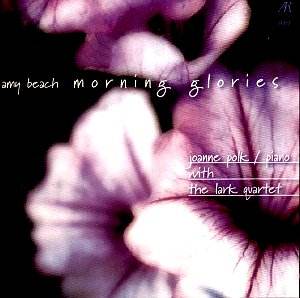
The Ambache Ensemble
on Chandos recently challenged the core
of this collection of Beach’s chamber
music – the Violin Sonata and the Quartet.
Challenged, yes, but they failed to
breach because these 1999 performances
are the superior ones – more flexible,
natural-sounding and idiomatic and in
the case of the Violin Sonata with a
better sense of pacing and superior
intonation. Premiered by the composer
and the irascible violinist Franz Kneisel,
famed and feared teacher, leader of
the Boston Orchestra, the sonata was
taken up by Ysaÿe and Pugno who
gave it at least one performance in
Paris, in 1900. It’s cast in four movements.
The opening movement is full of gentle
lyricism, and the Pascal/Polk duo catch
very well the musing intimacy that gives
it such lift and life. They also catch
the elasticity of line without which
the movement tends to fracture into
dainty reflection and are tighter in
tempo and in terms of thematic incident
than their Chandos rivals. They give
the start of the Scherzo a deceptive
sense of introversion but give good
value to the piu lento section that
delves into more reflective, wandering
lines. Marked con dolore, the
piano opens the Largo with real nobility
of utterance and there is increasing
turbulence alongside the intense and
soaring cantilena and playing in alt
even if Beach does rather stretch her
line too far. The driving, late Romantic
finale is enjoyable with ingrained lyrical
reminiscences of earlier themes and
a three-voiced fugue, which itself reminds
one of the fugal section in the first
movement. These two players are certainly
more up to tempo than their English
counterparts and take the con fuoco
instruction rather better to heart.
The Quartet was only
published after Beach’s death. Begun
in 1921 it was completed in 1929 in
Rome. She uses Alaskan Inuit songs –
as she had before in her 1907 piano
piece Eskimos. I like the way
the Lark Quartet bring out the shifting
chromaticisms here as indeed they do
a sense of cool intensity and intimations
of bleak abstraction. This is an intensely
contrapuntal work with a keening, intimate
texture. It is in one movement though
fairly clearly sub-divided into three
sections with a final recapitulation.
It’s a work with a decidedly austere
profile, enriched by tremolandi, and
a fugato section that may remind one
of the corresponding fugato in the Violin
Sonata. Above all there’s purity and
intimacy here in this fine performance.
The Trio is a work
of summation. It was written in 1938,
a late work in which Beach returned
to earlier compositions and used them
anew or, in her down to earth words
– "Trying a work from old material.
Great fun." And so it is – three
brief movements rich in Debussyian wistfulness,
with strong reminiscences of her Brahmsian
piano past (see parts of the Violin
Sonata for more but no Liszt in the
piano writing that I can hear). She
charts an eclectic compositional course,
ending with a fine marching finale,
chock full of confident syncopation
and real animation. Great fun indeed.
Part of Arabesque’s
invaluable Beach series this shouldn’t
be overlooked in the welter of Joanne
Polk’s solo piano works. These are just
as valuable and have the advantage of
a fine recording and dedicated, understanding,
expert performances.
Jonathan Woolf



 Diane Pascal (violin) and Joanne Polk (piano)
*
Diane Pascal (violin) and Joanne Polk (piano)
*