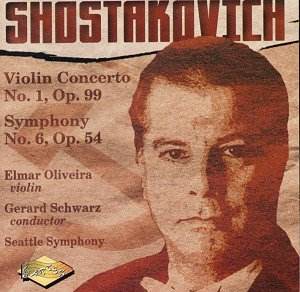
It’s unusual to see
the First Concerto coupled with the
Sixth Symphony. These days headlining
violinists will couple the First with
the Second Concerto, or make associations
with the Tchaikovsky, or with Prokofiev
No.2 (a favourite coupling – see Repin
and Mullova; Vengerov has coupled it
with Prokofiev No.1) But Artek has instead
opted for a discriminating conjunction
of the 1939 Sixth Symphony and the First
Violin Concerto, written just after
the war but revised and reworked in
1955. Oliveira is a patrician artist
and has long attracted the admiration
of discriminating listeners, though
chances of hearing him in Britain, at
least, have lessened over the last decade
or so (the only time I saw him in concert
was in the Barber Concerto many years
ago).
His is a reserved and
subtle reading of the Concerto. Though
the opening flourish under Schwarz is
quite robust, at an Oistrakh/Mravinsky
tempo, the Oliveira/Schwarz team doesn’t
bring the same kind of cumulative weight
to the Nocturne and theirs is a less
arresting but more meditative approach,
more a Preludio perhaps. I have to say
that there is a distinctly muted air
to the playing and to the recording
level as well. The Scherzo is fluid
and fleet with good wind contributions
and in the great Passacaglia there is
a sense of nobility and restraint, with
restricted vibrato usage and tone colouration
(not that Oliveira is deficient; he’s
a master of vibrato usage but here he
deliberately concentrates his tonal
resources). At a slower tempo then the
one Oistrakh habitually took Oliveira
is also less emotive; he’s less italicised
than Mordkovitch can sometimes be (with
Jarvi), and lacks those off-putting
withdrawals of tone that Midori indulges,
but also less affecting, and the finale
isn’t quite as cutting as it could be.
The sound can also be problematic and
the difference between its recession
and the searing sunlight of the Chandos
for Mordkovitch is huge. I tend to prefer
1957-1965 Oistrakh in this work (we’d
better not expand the discussion to
include another favourite, Kogan), even
though the sound on some of the live
performances (as for example in the
Oistrakh in Prague box) is not pretty.
In the end though this Artek performances
tends to promote cohesion and consolation
somewhat at the expense of the angst
and drama.
The Sixth Symphony
is tough to pace and order. The long,
opening and tragic Largo is followed
by an Allegro and a Presto finale and
only the most acutely perceptive conductors
can instil, from the first bars, the
inexorability of the schema, its rightness.
Haitink has the command and his performance
has a degree of nobility whilst Jarvi
has a visceral grip that screw tighter
and tighter and he takes fast tempi
for the last two movements. That is
Schwarz’s perception as well; his Largo
doesn’t incline either to Bernstein’s
deliberation (Bernstein’s 22.23 to Schwarz’s
20.59) or to Rozhdestvensky pressing
and urgent 17’11 – he followed in the
Kondrashin tradition of speed here)
but his last two movements are very
quick indeed (5’54 and 6’51 respectively).
As in the Concerto recording I don’t
feel that Schwarz really uncovers much
of the profounder schisms in the Largo
and for all its velocity, and whilst
woodwind articulation remains admirably
secure, his Presto doesn’t really bite.
To that extent this
brace of recordings achieves a degree
of emotive consonance without ever really
getting to the heart of the matter
Jonathan Woolf



 Elmar Oliveira (violin)