Make a small donation(£1, £2, £5) here Classical CD and DVD reviews. MusicWeb is not a subscription site and it is our advertisers that pay for it. Please visit their sites regularly to see if anything might interest you. Purchasing from them keeps MusicWeb free.

Classical Editor: Rob Barnett                               Founder Len Mullenger


BUY NOW 

Crotchet   AmazonUK   AmazonUS

Carl Maria von WEBER (1786-1826) - completed by Gustav Mahler (1860-1911)
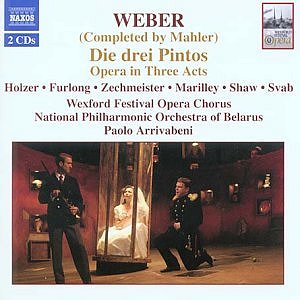
Die drei Pintos, (The Three Pintos) - comic opera in three acts
First presented on 20 January 1888, Leipzig.
Don Pantaleone, a nobleman from Madrid, Robert Holzer (bass); Don Gomez, a nobleman from Madrid, Peter Furlong (ten); Clarissa, Don Pantaleone's daughter, Barbara Zechmeister (sop); Laura, Clarissa's maid, Sophie Marilley (mezzo); Don Gaston Viratos, Former student from Salamanca, Eric Shaw (ten); Don Pinto, a country nobleman from Castrilla, Alessandro Svab (bass); Innkeeper, Stewart Kempster (bass); Inez, the Innkeeper's daughter, Sinead Campbell (sop); Ambrosio, Don Gaston's valet, Ales Jenis (bar)
Wexford Festival Opera Chorus
National Philharmonic Orchestra of Belarus/Paolo Arrivabeni
Live recording of the 2003 Wexford Festival Opera production
Recorded at the Theatre Royal, Wexford, Ireland, on 22, 25, 28, 31 October 2003
NAXOS 8.660142-43 [39.07+75.15]


The Wexford Festival was founded in 1951. It aims to present three rarely performed operas each year. The performances are spread over eighteen days and draw audiences from all over the world. Notable names such as Mirella Freni and Ugo Benelli appeared at Wexford in their early careers, gaining much valuable experience and exposure.

On completion of his opera Der Freischütz in the summer of 1820 Weber decided on a comic opera, Die drei Pintos, to a libretto written by Theodor Hell. He worked on the score during 1821 but complications over dedicating it to the King caused him to put the work aside. He never completed it. His plan was for the opera to consist of an overture and sixteen numbers. When Weber stopped work there were only sketches for seven items. Weber’s widow passed the sketches to Meyerbeer for him to complete the work. He did nothing with them for twenty years before declaring the task to be impossible. In 1886 the young Gustav Mahler, then aged 26 and with none of his compositions published, undertook the task. He found that the sketches needed not only orchestration but to be figured and harmonized as well. Mahler filled out extra material from Weber’s other music. In an erudite sleeve-note, Michael Kennedy gives the final scenario with indications of which ‘extra’ numbers were chosen.

The implausible plot concerns the substitution, twice, of Don Pinto on his way to Seville to marry Clarissa who is in love with Gomez. Needless to say the second substitution makes Gomez the third Pinto and he marries Clarissa. Eventually the real Pinto turns up and Clarissa’s father is furious, but all ends happily. A happy outcome cannot be posed for this recording. The best live recordings come about when audiences stifle their coughs and limit their applause to the ends of scenes or acts. With recordings of live opera performances there are the further complications of off-microphone singing and the noise of stage movement, the latter being beyond the control of the recording engineer. In a comic opera there is likely to be much coming and going and audience laughter if the performance is going well. It does go well here, but I have to admit to finding so much extraneous noise seriously limiting enjoyment and appreciation. Consequently I cannot seriously recommend this recording to those interested in Weber’s intentions or Mahler’s realisation. I do realise that when such recordings are envisaged, the recording company does not know how the production will pan out and they take a gamble. Those interested in the opera should pursue the early 1970s RCA recording with Lucia Popp, Werner Hollweg and Hermann Prey. The only people likely to enjoy this recording are those who were present at the Wexford performances and who want a memento of the occasion.

Robert J Farr

Advertising Rates
Visitor stats
MusicWeb International
has over 21,000 Classical CD reviews on offer


Gerard Hoffnung Concerts &
The Bricklayer Story

Naxos Classical

Australian Eloquence CDs on Buywell.com


New Releases

Hyperion
New Releases


Guild Music


MusicWeb sells the Polish
catalogue CDAccord
£10.50 post free W-W


MusicWeb sells the
Arcodiva catalogue
£12.00 post free W-W


Price Reduction: £11.00
post-free
world-wide
Try it and see - Sale or Return


MusicWeb can now offer you discs from the following catalogues:
Prices include postage

[Acte Préalable £13.50]
[Arcodiva £12.00]
[Ashgate Music Books]
[Avie from £6.25]
[British Music Society £13.49]
[CDACCORD from £10.50 ]
[ClassicO £12.50]
[Hallé from £11]
[Hortus £14.99 ]

[Lyrita ONLY £11.00 ]
LYRITA Sale or Return
[Onyx £12.00
]
ONYX Sale or Return
[REDCLIFFE £11 ]
[Tactus £11.50 ]
[Talent from £12.00 ]
[Toccata Classics £12.50 ]

MusicWeb Recommended Recordings 2008

DISCS OF THE YEAR 2007


Return to Index


Reviews from previous months
Join the mailing list and receive a hyperlinked weekly update on the discs reviewed. details
We welcome feedback on our reviews. Please use the Bulletin Board.  Please paste in the first line of your comments the URL of the review to which you refer..


You can purchase CDs and Save around 22% with these retailers: