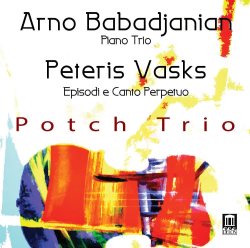
There’s no compelling logic for conjoining these two piano trios, other than a generalised sense of the works’ frank expressivity.
Arno Babadjanian’s Trio, one of his best works – though not quite on a par with his Violin Sonata – was composed in 1953 when the Armenian composer was in his early thirties. Its ethos is
fin de siècle fused with Late-Romanticism, inclining towards a richness of expression both melancholic – in its very opening paragraphs – and more extrovert. His gift for melodic distinction is heard at its finest in the central slow movement where the violin soars over a rich bed of nostalgic piano writing, the cello then adding its own commentary. The Potch Trio ensure that the music’s essential refinement is honoured, shaping dynamics – especially pianissimos – with perception. The music’s stance is turned inward here through intelligent modifications of vibrato – not too much – thereby allowing the folkloric dance in the finale to emerge the more dramatically. Somewhat Bartókian, this engaging music slows for the second subject before ratcheting tension for a rhythmically vital, energetic finale.
By contrast Peteris Vasks’ Trio
Episodi e Canto Perpetuo is considerably more allusive. The composer has written an extensive commentary in the score in which the titles of the eight episodes - Crescendo, Misterioso, Unisoni, Bulesca, Monologhi, Canto Perpetuo, Apogeo e coda – give a strong clue as to the Trio’s expressive journey. There are plenty of timbral contrasts here, moments when the piano’s sparse trills act as a prompt and angular agitated repetitive writing – active minimalism, if you will. One of the most impressive movements of all is Episode 5, the monologue, in which nostalgia and rapt melancholia – qualities shared here with the Babadjanian – co-exist with the piano’s repetitive tolling. Vasks reserves his most lovely writing for the penultimate movement, the Canto, which enshrines a glorious melody that gradually thins to usher in the finale that furthers recedes to a disappearing point.
Delos has picked up this 1997 recording and worthily so, as the Potch Trio project much of the two works’ essential spirit with care and sympathy.
Jonathan Woolf
Previous review:
Brian
Reinhart