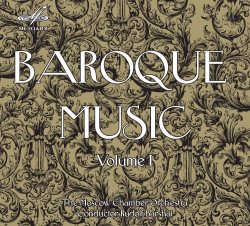
There’s a critical commonplace that applies to Russian baroque performances of the 1950s and 1960s which concerns the heaviness of performances. This relates to rhythm (heavy) and also string density (rich). Together this has given Russian performances of Bach, in particular, a reputation for stolidity that not all performances and recordings actually deserve. This is a criticism that has even extended to Rudolf Barshai’s Moscow Chamber Orchestra recordings, which are restored here. The earliest date from 1958, and the most recent from 1971. The programme is arranged by composer so the music is non-chronological. Albinoni’s Concerto for oboe and orchestra in B flat major is played by E. Nepalo, with an admixture of stately pointing and warm expression in the central movement. The companion Albinoni work takes us back to 1958. Stern auditors will point to the over-emphatic rhythm in the traversal of the opening paragraphs which courts the portly, though the ensuing movements are markedly more successful.
We are introduced to three leading Russian players in Vivaldi’s Concerto for flute, oboe, bassoon and continuo - thoughtful and expressive chamber music. Note too that the keyboard continuo is provided by the equally distinguished Mikhail Muntian. Telemann is represented by his
Wassermusik, his Orchestral Suite (Overture) in C major, recorded in 1964. Here the Moscow Soloists are allowed broadly unfettered opportunities for characterisation, which they take with old school energy. The winds come though well in the
Bourée and the string pizzicati and well-balanced harpsichord are a virtue.
Aeolus is excitingly dramatic, each movement well coloured. The final piece is Handel’s Concerto Grosso in A flat, HWV330, recorded in 1959. They take Handel with rather more of a grand seigneurial approach. Gestures are more unabashed and extrovert. The Aria is rather pious, though it is affectionately phrased.
This is more of snapshot of Barshai’s work in this repertoire with his Moscow Soloists than a realistic proposition for purchase, I’d have thought. Its appeal will lie principally with admirers of the eminent conductor, who will doubtless welcome back recordings that still possess apposite breadth and sincerity.
Jonathan Woolf