| 
|
Frédéric CHOPIN (1810-1849)
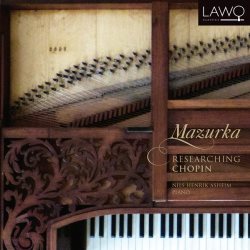
Mazurkas: Researching Chopin
see
end of review for listing
Nils Henrik Asheim (square piano)
rec. 13-15 September 2011, 12 October 2012, Ulefos Hovedgaard, Ulefos, Norway
LAWO CLASSICS LWC 1049 [64:23]
Nils Henrik Asheim chooses a superb, characterful piano from the 1830s for his hour of Chopin mazurkas. He also, happily, chooses many of my favourite pieces, creating a good, very worthwhile recital.
First, consider the instrument: it’s a Collard & Collard square piano, a compact example that would have been suited to homes or chamber music spaces in the 1800s. The piano doesn’t have much in the way of a sustaining capability, and it also has the warmer, smaller, more varied sound of fortepianos of the time. As Asheim remarks in his note, the topmost and lowest octaves sound like they might be different instruments. The top notes have a pearly, precious quality, while the bass is not at all lacking in presence. There is a loss of heft across the board, though, and if you don’t like fortepianos which sound “thin”, you won’t like this much. The CD’s inside sleeve is a full photograph of the piano’s innards.
As for Asheim, he is forced by his instrument to stress the rhythmic nature of these pieces, which are, after all, dances. He also deploys some of what we call “romantic” pianistic effects: a lot of rubato, the occasional emphasized pause, separated left and right hands or arpeggiated chords. Not all of these work; near the end of Op. 6 No. 2 it sounds like one of the arpeggiated chords gets bungled and converted to a wrong note or two. Occasionally (e.g. Op. 7 No. 3) Asheim is simply too fast.
Those minor quibbles don’t stand between the disc and my recommendation, since Asheim does have a cohesive view of how the mazurkas should go. His view fits hand-in-glove with the chosen instrument. For me there’s great pleasure in hearing these pieces on an instrument much like the ones Chopin would have been using, and wondering if this is how the mazurkas really sounded in Parisian salons of the 1840s. Intimate, but not boxy, sound makes this even less of an imaginative leap. If you’re really interested in the historical authenticity of this disc, maybe you’ll think the occasional wrong note is the icing on the cake.
Brian Reinhart
Mazurkas included: Op. 6 Nos. 1-3, Op. 7 Nos. 1 and 3, Op. 17 Nos. 2 and 4, Op. 24 Nos. 1, 2, and 4, Op. 30 No. 4, Op. 33 Nos. 1-4, Op. 56 No. 2, Op. 59 No. 2, Op. 63 Nos. 2 and 3, Op. 67 No. 4, Op. 68 Nos. 2-4
 |
 |
|