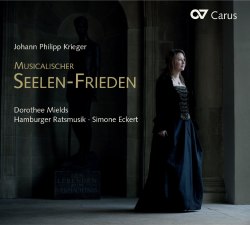
Johann Philipp Krieger was a tireless, indeed indefatigable composer
of church music. It’s calculated that during his 45-year career
he composed no fewer than 2,150 cantatas - some 80 have survived -
and Simone Eckert’s notes, to which I’m indebted, point
out Krieger’s exceptional industry, as well as his considerable
annoyance when some or other ‘bungler’ submitted a composition
in his absence.
In this disc we hear a selection of his music including sacred concertos
from the collection called Musicalischer Seelen-Frieden - perhaps
surprisingly for someone so prolific his only published sacred music
collection -four of which are heard in premiere recordings.
Krieger’s contribution to this genre was amongst the most significant
by a German composer of his time. His most important trio sonatas
are also in this inventive disc.
Krieger inherited a Franco-Italian musical direction, and had the
good fortune in particular to move in a cosmopolitan milieu rich in
Italian composers. He was active, and greatly admired, in Vienna from
which city he became court Kapellmeister in Wiessenfels and it was
here that all the works in this disc were written.
The four Psalm settings are graceful and most attractive pieces showing
some influence of Schütz and Buxtehude. They’re fluid and
thoughtfully set out for the soprano soloist and small accompanying
group of two violins and basso continuo. Psalm 31, Herr, auf dich
trau ich, sports a delightful, exhilarating Allelujah and Es
stehe Gott auf (Psalm 68) is more compact still at seven minutes
in length but just as convincingly set. Soprano Dorothee Mields sings
beautifully throughout. Hers is a voice of great purity and refinement,
possessing much subtlety within a calibrated palette of colours. She
sings without much vibrato. She enjoys the Italianate divisions of
Gott, man lobet disch in der Stille where Krieger employs a
great deal more floridity than in the companion settings. She is imaginatively
accompanied by Eckert and the Hamburger Ratsmusik.
The three trio sonatas make for a good contrasted programme, though
no doubt Mields’s admirers might have wanted more from her.
They show the prevailing Italian concertante influence - he had known
Legrenzi, Cavalli and Ziani, after all, amongst others, and indeed
earlier in his career had brought nine Italian virtuosi with him to
perform in Bayreuth. The music of the trios is sophisticated and expressive
and admirably co-opts the Chaconne, for instance, to Krieger’s
own technical and expressive uses.
I hope we’ll hear more from these musicians in this repertoire;
as this is a conspicuously admirable disc.
Jonathan Woolf