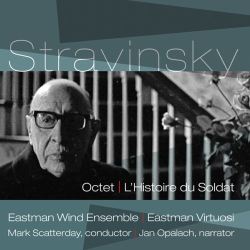
This is an intriguing release, but I don’t
feel the need to linger overly long on its qualities. Stravinsky’s
Octet for Wind Instruments is very well played here with only
occasional very minor fluffs when cornering through some of Stravinsky’s
trickier passages, such as the poor flute at 2:26 in the first movement.
The trouble is everything is mercilessly exposed with the recording
in an acoustic drier than James Bond’s Martini. Compared to my
reference under Robert Craft on
Naxos
8.557507 it sounds as if the musicians are working in a broom cupboard,
and it is a credit to them that they make the music sound so effective
in these circumstances. While the playing is excellent, the sonorities
don’t blend as much and there is a rather boxed-in feel, that
of potential energy rather than dynamic flow and freedom of expression
entirely released. You hear this difference most acutely when put up
against the Craft/Naxos version which is admittedly perhaps even a bit
over acoustic, but is certainly a more satisfying listening experience
and a much more rousing performance.
L’Histoire du Soldat lives or dies by its narrator, and
former opera star Jan Opalach does pretty well. We’re still plagued
by that dry acoustic, which may at times remind ageing UK readers of
the soundtracks to the work of Oliver Postgate. Opalach’s accent
is American of course, but by no means hard to follow. It’s only
when you encounter the likes of Jeremy Irons on the Sony Classics label,
working with the Columbia Chamber Orchestra and conducted by the composer
in 1967, that you are treated to a real multiplicity of characters.
Irons' performance was apparently added long after the fact, but his
is an extraordinarily good performance, full of little subtleties and
superbly understated for the most part. Irons’ Soldier is something
of an Eton schoolboy and he is helped by some production trickery, his
voice divided between two channels when in conversation, but his narration
is utterly captivating and at times disturbingly haunting. Opalach’s
characterisations are good, but without quite the sense of believable
fantasy which Irons manages. The text has been expurgated somewhat as
well. For instance, we aren’t treated to the Soldier’s girlfriend’s
married and pregnant status on his return, or his coarse swearing at
the Devil when he finds out what has happened.
As with the
Octet the musical performance with this Avie recording
is effective but utterly closeted. The tuning of the violin is something
of a trial each time - too much of a ‘performance’ where
the Columbia player convinces with less extreme
glissandi. There
are few enough recordings of
The Soldier’s Tale in its
complete form, and I wish I could welcome this one more. There is another
Naxos alternative, 8.55366-2, with the Northern Chamber Orchestra conducted
by Nicholas Ward, which is very good. In this case the characters are
taken by three different actors which creates an entirely different
dynamic to the one conducted by Stravinsky so it’s not an entirely
fair comparison, but in any case I can’t say I prefer this to
Jeremy Irons’ vocal virtuosity. The Devil sounds more like a genial
Great-Uncle than a menacing force of evil, and the Michael Flanders
adaptation is also less pithy than that used in the Columbia recording.
For the want of a decently spacious recording venue I’m afraid
this Avie disc loses out to pretty much all of the available alternatives
in both of these works, which is a great shame.
Dominy Clements