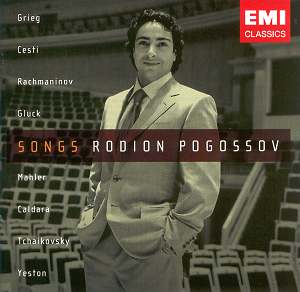
EMI's 'Debut' series has been instrumental in launching several
young singers and artists on the threshold of international careers.
One need only remember Katarina Karneus, Jonathan Lemalu and
German cellist Daniel Muller-Schott who today belong to the
top of the trade. Listening to this recital by this young Moscow-born
singer I feel pretty sure that here is another artist destined
for great things.
His choice of repertoire is catholic, covering the baroque,
classics and the musical, while the core of the recital draws on
songs from the central Romantic period. This also gives Pogossov
opportunities to show his linguistic prowess, singing in Italian,
German, English and native Russian, even opening the recital with
Henrik Ibsen's Med en vandlilje (With a Water Lily)
in perfectly acceptable Norwegian, a feat that very few non-Scandinavians
manage. There is the odd un-idiomatic vowel sound, but these
are exceptions. His open vocal production and clear enunciation
also contribute to the overall good impression.
Pogossov is a true high baritone, with a voice that is and has
a wonderfully smooth half-voice and ringing top notes. The closest
comparison I can think of is Ingvar Wixell, especially as he
sounded in the 1950s and 1960s before his international
breakthrough. The timbre is very similar and there is that quick
vibrato that some critics call grittiness. I mention it only to
give some idea about what he sounds like. I have always thought
that Wixell mastered his voice excellently and that little grit in
the tone only made him easily recognisable. Pogossov has a natural
way with phrases - he always gives the impression
of going somewhere. It is also a powerful voice but is used
with wonderful discrimination. What impresses most is his seamless
shading of nuance. The last of the Grieg group, Ein Traum (tr.
5) perfectly shows his capabilities. It has hard to imagine
more expressive Lieder singing.
His singing of Rachmaninov and Tchaikovsky is beyond reproach and,
as I have remarked on several occasions, singing in one's mother
tongue has a tendency to liberate the voice from tensions,
bringing forth an innate natural beauty. Domingo singing in
Spanish, Bjorling in Swedish, Kiri Te Kanawa in Maori are good
examples. In the mysterious silence of the night (tr.
8), one of the finest songs in Russian, has all the best characteristics
of a great Lieder artist, making Pogossov probably the best
Russian baritone to appear since Hvorostovsky hit the headlines
more than fifteen years ago.
Gluck's O del mio dolce ardour (tr. 11), often sung with ponderous
reverence, is here swift without being hurried. It may be more
romantically expressive than classically balanced but with
exquisite shadings.
There is also a youthful freshness to the Mahler cycle, again eagerly
forward-moving. He is noticeably faster than Thomas Hampson's
comparable recording with piano on Teldec, beating him by 45
seconds in the first song. He shows his smooth half-voice to
good effect in Ging heut Morgen and is properly dramatic
in Ich habe ein gluhend Messer, singing with biting
intensity. In the inward final song Die zwei blauen Augen
he is almost as moving as the aging Heinrich Schlusnus in his
legendary DG recording. The Caldara aria shows his superb breath
control and the four Tchaikovsky songs promise a future Eugene
Onegin - the biography tells us that he has already been singing
Yeletsky in The Queen of Spades. Especially impressive
is Again, as before, alone (tr. 18), one of the composer's
last works, completed just before the Pathetique. He
is also a demonic Don Juan in the burlesque serenade. The song
from Nine is a fitting encore, sung with disarming simplicity.
With the ever-reliable Malcolm Martineau at the piano we can rest
assured that not a nuance in the accompaniment is missed. In
fact, the only thing I miss about this issue is the sung texts.
They are on the other hand available on the EMI Classics website.
It is always thrilling to hear a young singer still on his way up
and with as yet not a scratch on his vocal cords. I am already
looking forward to hearing him again. I wouldn't in the least
be surprised if Rodion Pogossov becomes one of the most sought
after baritones during the next two decades.
Goran Forsling



 Rodion Pogossov
(baritone); Malcolm Martineau (piano)
Rodion Pogossov
(baritone); Malcolm Martineau (piano)