This is an ingenious
recital, excellently planned and played.
It brings us a triptych of works, one
canonic for the chosen ensemble – the
Bartók – one clothed in unusually
spare guise – the Stravinsky – and one
new to disc and a wholesome and bracing
addition to the repertoire, the Camilleri.
Owing its genesis to
the composer’s visit to Chetham’s School
of Music in 2004 Camilleri’s
Concerto for two pianos and percussion
was completed the following year and
unveiled in August 2005. This naturally
enough is its premiere recording. It’s
an exciting, often advanced work, tonal
in essence but fully prepared to draw
the listener’s – and performers’ – ears
into rich new sound-worlds. The percussion
adds a veritable Kandinsky of colour
or else assumes a rhythmic independence
that galvanises the exchanges, dialogues
and soliloquies between the instruments.
The opening movement visits some jagged,
dynamic, explosive figures, though it
ends in a kind of speculative, tentative
indecision. Strong contrasts are a feature
of the concerto and the Bartók
was clearly one of the thoroughly absorbed
models, both in terms of sound distribution
and the level of internal energy generated.
The saturnine piano writing contrasts
with more reflective material, the percussion
adding jazz-based glee – puckish and
insolent – that manages to drive the
pianos up the keyboard. The finale opens
with Mussorgskian catacombs but there’s
plenty of powerhouse declamation and
dynamism here, a really exciting end
to a broad ranging and inventive new
work.
The Stravinsky is
unusual enough in this two piano reduction
to make one listen anew with freshly
cleansed ears. The clarity thus revealed
brings one closer, perhaps, to the compositional
impulses that drove Stravinsky. It can’t
replicate, quite obviously, the more
primitive dynamism, the remarkable colour
or the sheer overwhelming newness of
orchestration and rhythm that the orchestral
work displays. Nevertheless when played
with such incision and verve as here
it’s exciting on its own terms. When
we hear the Ritual of the Rival Tribes
and the Procession of the Sage
played with as much energy and pulsating
drama as here, we can happily enjoy
the whole splendidly realised performance
– and savour its relative rarity value
as well.
The Bartók
has received a number of compelling
readings over the years but its necessity
in this programme is obvious and very
welcome. Kathryn Page and Murray McLachlan
convey rather well the quasi-orchestral
power of the first movement and the
ensemble brings colour and definition
to the writing, as well as clear delineation.
The shimmering intensity of the central
movement builds properly and powerfully,
whilst the rhythmic snap of the finale
is notable. They don’t overlook the
caustically witty ending.
With a spacious but
focused recording set-up strands come
through with clarity but no hint of
coldness. This is a challenging and
successful recital. It spreads over
onto two discs but is priced as one.
Jonathan Woolf
see also review
by David Hackbridge Johnson



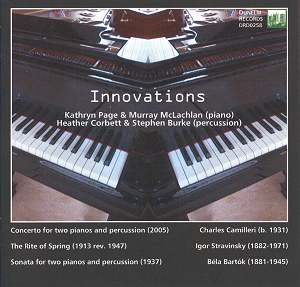
 Kathryn Page; Murray McLachlan (piano)












