There was a time, during
the LP era, when Hoddinott’s music was
reasonably well represented in commercial
recordings, particularly on Decca and
Argo. Two pieces here were originally
released by Argo (Dives and Lazarus
and the Viola Concertino),
whereas the other two derive from Unicorn
(Sinfonia Fidei and Nocturnes
and Cadenzas). The Third
and Fifth Symphonies, recorded by Decca,
were re-issued on Lyrita SRCD331 reviewed
here some time ago. So far so good
but recordings of several fine pieces,
also recorded by Decca or Argo, have
never been re-issued in CD format so
far, neither has a very fine RCA LP
(RL 25082) from as far back as 1977.
It is thus quite nice to be able to
listen again to some of these recordings,
in the hope that more of them might
eventually be re-issued too, maybe through
the Explore
label.
From quite early on
in his prolific composing life, Hoddinott
found his own voice, and was able to
compose a substantial output of highly
personal works, the music of which is
nevertheless immediately recognisable.
However, as Rob Barnett mentioned in
a recent review
of Hoddinott’s Investiture Dances
Op.66, the composer has
never been afraid to compose shorter,
highly entertaining pieces in a more
accessible, amiable idiom. Some of these
works were recorded a long time ago
but to date not re-issued.
The Viola Concertino
Op.14 is an early, but quite
characteristic work, in which Rawsthorne’s
influence may still briefly surface,
but which manages to be already quite
individual in tone and design. The composer
already displays his life-long liking
for palindromic structures, as well
as his instrumental and orchestral flair.
The title of the work may be a bit misleading,
for neither the musical substance nor
the actual size really justify such
a diminutive title. In fact, this is
a substantial work scored for small
orchestra, so that the soloist is never
drowned by the orchestra and the instrument
may thus sing in its most eloquent register.
Later, however, Hoddinott’s orchestral
mastery allowed him to compose works
such as Nocturnes and Cadenzas
Op.62 and Noctis Equi
Op.132 (both for cello and orchestra)
in which larger orchestral forces never
obscure the soloist’s discourse.
Hoddinott’s slow movements,
either in his symphonies or in his concertos,
are very often cast as nocturnes. He
also composed an orchestral work titled
Night Music Op.48. By
the way, the first movement of the Viola
Concertino is a nocturne too. No wonder
that his first cello concerto was titled
Nocturnes and Cadenzas Op.62,
thus perfectly summing-up the work’s
global structure consisting of three
nocturnes interspersed by two cadenzas
functioning as bridge passages. The
work as a whole is structured as a large-scale
arch-form, one of the composer’s favourite
designs. As already hinted earlier in
this review, the scoring is masterly,
carefully balanced so that the orchestra
never competes with the soloist. The
scoring also emphasises a characteristic
of Hoddinott’s mature orchestral writing
in the subtle and telling use of percussion.
This is one of Hoddinott’s most impressive
masterpieces, and I welcome its return
to the current catalogue.
The choral works are
quite contrasted, although obviously
from the same pen. Dives
and Lazarus Op.39 was
commissioned by the Farnham Festival
for the combined forces of Aldershot
High School and Farnborough Grammar
School, with two adults soloists (soprano
and baritone). The music is somewhat
simpler and more straightforward, although
the composer never writes down to suit
amateur musicians. The work is strongly
structured and tightly knit through
the use of recurring germ cells, while
the vocal parts are eminently grateful
to the voices. This recorded performance
by professional musicians generously
confirms the work’s many intrinsic musical
qualities.
Sinfonia Fidei
Op.95 is a large-scale piece
for soloists, chorus and large orchestra,
at once a work clearly devised for professionals
and one of Hoddinott’s most direct public
statements. I heard this performance
when it was released in LP format, and
had then some doubts about it. I realise
now that my doubts were mostly due to
Unicorn’s digital recording made in
the perspective of the oncoming CD format.
It did not always come off satisfyingly
in LP pressings. I thus welcomed this
opportunity to hear it again, and I
gladly admit that my doubts have now
been washed away. Sinfonia Fidei
is a mighty, impressive piece of music.
All these performances
were – and still are – magnificent,
and the recorded sound does not show
its age. As mentioned earlier, there
are still many fine Hoddinott recordings
lingering in Decca’s and Argo’s archives
that badly deserve to be re-issued.
I hope that they will soon surface again.
Anyway, full marks for these excellent
re-issues that put some of Hoddinott’s
superb, sincere and honest music back
into the catalogue.
Hubert Culot
see also review
by Colin Clarke
Lyrita
Recorded Edition catalogue



 for
details
for
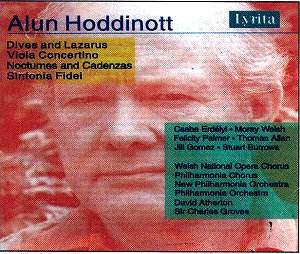
details Felicity Palmer (soprano)a; Jill
Gomez (soprano)d; Thomas Allen (baritone)a;
Stuart Burrows (tenor)d; Csaba Erdélyi
(viola)b; Moray Welsh (cello)c;
Welsh National Opera Chorusa; New
Philharmonia Orchestraab; Philharmonia
Chorusd; Philharmonia Orchestracd;
David Athertonab; Sir Charles Grovescd
Felicity Palmer (soprano)a; Jill
Gomez (soprano)d; Thomas Allen (baritone)a;
Stuart Burrows (tenor)d; Csaba Erdélyi
(viola)b; Moray Welsh (cello)c;
Welsh National Opera Chorusa; New
Philharmonia Orchestraab; Philharmonia
Chorusd; Philharmonia Orchestracd;
David Athertonab; Sir Charles Grovescd












