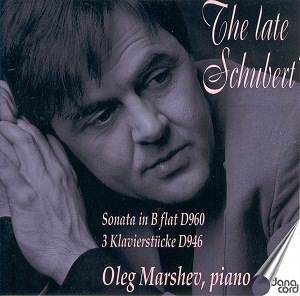
For this release Danacord, the Danish-based independent
label, have chosen Oleg Marshev as their soloist. He was
born in Baku, Azerbaijan, then part of the former Soviet
Union and also the birthplace of Rostropovich.
Marshev trained with Valentina Aristova at the Gnesin
School for highly gifted children and with Mikhail Voskresensky
at the Moscow Conservatory where he completed his Doctorate
in 1988. He was awarded the Diploma with Honour. Marshev
plays these Schubert works on a Steinway Model D piano.
Schubert wanted to dedicate his Piano Sonata No.
21 to Hummel but his Austrian music publisher changed
that distinction to Robert Schumann. In a review Schumann
actually questioned whether or not the score together with
the C minor and A major Sonatas were ‘last’ works
as claimed.
Music writer David Ewen is of the opinion that the shadow
of Beethoven hovers over most of Schubert’s piano sonatas
but only in these last three sonatas can Schubert be said
to be truly Beethovenian. The drama and majesty of the sonata
has noticeable Beethovenian echoes although Schubert’s
rich and deep trademark voice is overriding. Many musicologists
consider this work to be his greatest sonata with its tonal
daring, impressive harmonic sureness and consistently expressive
pianistic treatment.
The first movement molto moderato starts off
with an expansive and eloquent melody that concludes with
a low trill in an air of mystery. The mystery deepens with
the second subject which begins in the key of F sharp major
and then lapses into F. The andante sostenuto movement
is a continual ascent towards the sublime, the starting point
being a poetic thirteen measure melody with religious overtones.
The scherzo is remarkable for the variety of its harmony
and the exciting alternations of major and minor. The allegro
ma non troppo finale is once again Beethovenian in its
storm and stress; it opens on a dramatic note in a foreign
key.
Schubert scholar Brian Newbould described the Klavierstücke as “precious
examples of art-concealing miniaturism”. Einstein stated
that these three substantial pieces parodied the popular
styles of the day. It is thought that the 1828 Klavierstücke were
originally intended for a third set of impromptus.
Critics have not always been kind towards them but, “they
stand well enough” according to music writer and pianist
Ateş Orga and “they occasionally reach the heavens”.
Oleg Marshev proves himself a sterling advocate of these
scores. He is thoroughly musical, totally involved, produces
an attractive tone and conveys a feeling of surety. In the
sonata the difficulties and manifold mood changes of the
opening movement are skilfully navigated. In the slow movement
the pianist captures the contemplative and reflective mood
superbly well. The short scherzo is dazzlingly performed
with as much charm as one could wish to hear. The impressive
Marshev interprets the dramatic concluding movement skilfully
with considerable prowess. In this man’s hands Schubert’s
ever-present mood of agitation and fervour is communicated
most convincingly. Throughout the Klavierstücke I
was especially impressed with the way Marshev breaths life
into the music with supple phrasing and subtle rubato. There
never seems to be any hint of self-consciousness from this
pianist who is to be congratulated for conveying the true
spirit of the music.
The booklet notes which are packed with information
are rather technical at times and the writing frequently
borders on the incomprehensible. Wonderfully recorded sound
from the Danacord engineers in a suitably resonant acoustic.
Michael
Cookson
see also review by Glyn Pursglove



 Oleg Marshev
(piano)
Oleg Marshev
(piano)