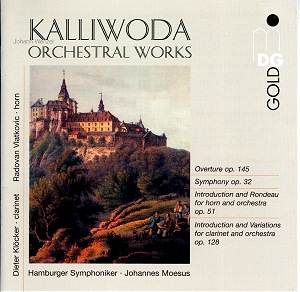
This
company has the knack for unearthing little nuggets of nineteenth
century repertoire. Here the attention is focused on Prague-born
Kalliwoda, for decades Kapellmeister at the court of the
prince in Donaueschingen, whose circumscribed career never
quite effaced his touring or stunted his ambitious compositional
programme. Retirement for Kalliwoda, at the age of sixty-five,
however proved unpropitious - no sooner had he moved to join
his family in Karlsruhe than he was dead.
The
programme here acts as a pleasing concert – an overture,
a clarinet and orchestra feature, than one for horn and orchestra
and then finishing with the big Third Symphony. The most
obvious feature of his composition is its indebtedness to
Weber. The woodland horn of the Overture certainly reinforces
this debt though the noble statement of the Fürstenberg Anthem – as
a princely mark of respect – attests to his proto-nobilmente
spirit. A slight lack of detailing in the recording – here
and throughout – tends to give rather a diaphanous gauze
with resulting loss of detail and impact.
The
Introduction and Variations was originally a four-handed
piano work, here expertly reworked for clarinet and orchestra.
Dieter Klöcker exploits a full, rich tone in this work, where
he proves adept at unfolding those Weber-like operatic curlicues
and digs into the early quasi-cadenza. His colleague, the
distinguished Radovan Vlatkovic, performs the Introduction
and Rondo, originally written for hunting or valve horn,
with total command. The orchestration here is rather subservient
with the exception of some bucolic drones in the lower strings
and a certain amount of peasant picnickery; the best moments,
other than the soloist’s security in both high and lowest
registers, are those little moments when the solo horn
indulges in dialogues with solo orchestral winds.
The
Symphony was lauded in Leipzig. And it is a strong work,
long on Sturm und Drang and noble Weber horn harmonies,
part late-Haydn, part early-Mendelssohn maybe - to be crude.
There’s
a stern first movement fugato and some hints of early romanticism
in the writing of the Poco Adagio – though even more notable
is Kalliwoda’s string divisions and wind writing, which is
ear-catching. The Minuet has bustly terpsichorean drive and
if the finale is rather four-square and predictable it is
certainly not a bore. It’s a most pleasing work – nothing
shattering or original but thoroughly well absorbed, clearly
laid out and expert.
The
notes are helpful and not too technical but as noted earlier
the sound is sometimes rather spread so there’s a slight
loss of immediacy. But that shouldn’t put off the determined
collector. Rare repertoire well performed deserves admiration.
Jonathan Woolf



 Dieter Klöcker
(clarinet)
Dieter Klöcker
(clarinet)