The conductorless
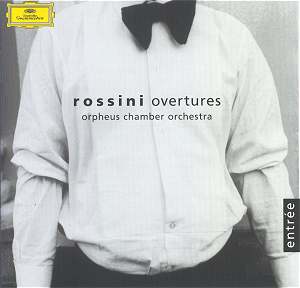
Orpheus Chamber Orchestra is on fine form in this programme
of music by Rossini.
The eight overtures
played are all from Rossini’s earlier operas – there’s no William
Tell here. Most follow the usual Rossinian pattern of
a slow introduction followed by two themes, the first most often
played by the strings, the second giving prominence to the winds.
A recapitulation of the themes is followed by a brilliant coda.
Along the way there are, without fail, some striking touches
of instrumental colour and one of Rossini’s characteristic crescendos,
built over an ostinato rhythm, more and more instruments added
as the music gets louder and louder. The results are so exciting
and stirring that even the rowdiest of early nineteenth century
audiences must have been dissuaded from idle chatter!
All of these overtures
belong to the period when Rossini was writing for relatively
modest forces. The dimensions of the music are well-suited to
a chamber orchestra such as the Orpheus, whose clear and relatively
small-scale sound allows the detail of the music to work in
ways that are not always evident in large orchestra performances
of Rossini’s overtures. Some conductors are tempted to exaggerate
the brilliance and colour of Rossini’s writing, to turn the
overtures into mere orchestral showpieces. There’s none of that
here, the music being treated with respect – without ever being
allowed to become over-solemn.
The allegro of the
overture to L’Italiana in Algeri is delightfully vivacious
and the following oboe melody is properly mischievous; the reprise
and the unexpected modulation are very well handled. One senses
the orchestra’s own sense of fun as the violinists use their
bows to tap their music stands in the overture to Il signor
Bruschino; indeed these performances convey a real sense
of musicians enjoying themselves.
There are plenty
of collections of Rossini’s overtures to be had on CD, such
as those by Riccardo Chailly and the National Philharmonic Orchestra,
by Charles Dutoit and the Montreal Symphony Orchestra, Sir Neville
Marriner and the Academy of St. Martin-in-the-Fields or Carlo
Maria Giulini and the Philharmonia Orchestra. All have their
attractions – as indeed does the collection by Toscanini (on
Aura Classics), even if the editions then in use were somewhat
corrupt, Rossini’s essential clarity varnished over, as it were,
with later additions. It would be quite wrong to think of this
reissued CD (last issued, I think, on DG 415 363-2GH) as ‘replacing’
or superseding any of these famous versions. But it deserves
to be heard alongside them, and no lover of Rossini’s music
is likely to be disappointed by it.
Charles Neiditch
is an accomplished soloist in the Introduction, Theme and
Variations, a piece not certainly written by Rossini. Its
Introduction is based on an aria (‘La pace mia smarrita’) from
Mosè in Egitto; the Theme employed in the ensuing variations
is from La donna del lago (‘O quante lacrime’).
What is done with these materials may, or may not, be the work
of Rossini himself; certainly the results are entertaining,
full of Rossinian gusto and appetite. It is played in spirited
fashion and makes an admirable ‘bonus’ to the overtures.
Glyn Pursglove
BUY NOW
Crotchet



 Charles Neidich (clarinet),
Orpheus Chamber Orchestra.
Charles Neidich (clarinet),
Orpheus Chamber Orchestra.











