I am at present
engaged in the translation of a fascinating article about
19th century French organ music by Joris Verdin for publication
in the US. Verdin tries in his article to correct some of
the 20th century's misunderstandings about 19th century organ
culture, attitudes towards the instrument and its music. In
it he draws a distinction between the attitudes of Widor and
his generation, and the attitudes of Lefébure-Wély and Franck
who were products of a church-music culture where the organ
was intended as a reminder of the joys of earthly life, a
distraction from God. The music played in the mass included
the grand offertoires, scherzos, cavatinas, polkas, marches
etc. Widor on the other hand saw, as with the many commentators
on church music of the time, (most notably d'Ortigue and Chateaubriand)
the organ as the ultimate religious instrument, and the organist
as the depictor of the mystic. This distinction is important
when one considers that Franck and Lefébure worked in an organ-playing
epoch where the organ was seen as any other instrument; as
a flexible tool for expressing human emotions. With Widor
and his contemporaries this idea becomes superseded, as Verdin
says "the technical means came first, the artistic consequences
were limited".
In addition it
is important to realise that in the course of the ten symphonies,
the changing attitude toward liturgical music in the French-speaking
world is reflected through the forms and styles used. Two
of the first three symphonies contain, in their final versions,
marches, the final two symphonies are freer, devoid of the
catchy rhythms of Widor's predecessors, and wholly based on
gregorian chant.
Widor of course
is the great father of the French organ symphony. Franck is
often said to have written the first example, but, in truth,
the Grand Pièce Symphonique sets the model purely in terms
of scale, and not of form.
These recordings
are a real puzzle in the context of what I've stated until
now. Marie-Claire Alain, recorded thirty+ years ago, delivers
extremely rhythmically straight performances, albeit she is
a little freer in the slow movements. On the one hand, Alain,
one of the most profoundly influential organists of her generation
was educated in the Widor tradition, being as she was a student
of Marcel Dupré. On the other hand she was at the forefront
of the classical revival, as her many Bach recordings, latterly
made on historic instruments attest. It is important to realise
that the classical movement in France affected also the performance
of its symphonic music, and, through the influence of figures
such as Norbert Duforque, the instruments on which the music
was played. Many beautiful 19th century instruments were lost
through his influence.
Which tendency
is prominent then in Alain's playing? Are these real recordings
in the true Widorian manner of playing? Or a sort of hybrid
based on Alain's background but heavily influenced by the
ideals of her generation? I suspect the latter is truer in
this instance. One of my reasons for this is the curious choice
of instrument for the majority of the recordings. The organ
at St Germain-en-Laye was originally built by Cavaillé-Coll.
Unfortunately I am quite unable to find out anything further
about it. On the basis of this recording it must have been
severely altered, some thin reeds high mixtured seem unduly
prominent. The unspoiled Caen Cavaillé-Coll sounds much finer.
I can't help but
come to the conclusion therefore that this doesn't represent
the best of Marie-Claire Alain. Whatever the truth of Verdin's
convictions, I long for a more monumental instrument, and
a more supple and lyrical approach. These rather claustrophobic
recordings provide an interesting glimpse into the performance
practice of some essential literature a generation ago, but
I believe not more than that.
Additionally it
is a shame that, despite the budget price, Apex couldn’t have
provided more information about the recordings, the instrument
and the performer.
Chris Bragg
BUY NOW
AmazonUK



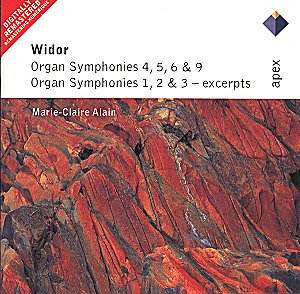
 Marie-Claire Alain (organ)











