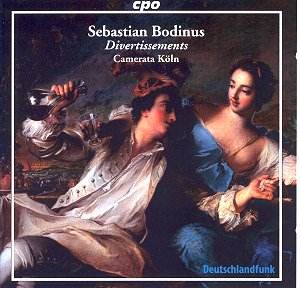
This disc is remarkable in more than one way. First of all,
Sebastian Bodinus is anything but a household name. Nevertheless
this 'minor master' appears to have written first-rate
music, as this recording proves. Secondly, the 'divertissements'
presented here have nothing to do with the 'divertimenti'
of the classical period. They are quartets: pieces consisting
of three equal upper parts and basso continuo, and combining
elements of the sonata da chiese, the concerto and the
suite. The quartet was very rare in the time Bodinus composed
his: the 1720s and 1730s. According to Johann Joachim Quantz "the
use of it never became very common; as a consequence, it
also cannot have been so familiar to everybody". The
best-known composer of quartets was Georg Philipp Telemann,
whose 'Quadri', published in 1730, were perhaps models
for the quartets of Bodinus, which belong to a six-part
collection of trios and quartets, which he started to write
in 1726.
Very little is known about Bodinus. He was born in 1700 in Saxe-Gotha;
the exact place and date of his birth are unknown. He was
educated as violinist, and in 1718 he entered the service
of Margrave Carl III Wilhelm of Baden-Durlach. At his court
in Karlsruhe the margrave also engaged Johann Melchior
Molter, who became music director in 1722. At several stages
of his life Bodinus worked elsewhere, but he always returned
to Karlsruhe, where he was appointed concertmaster in 1728.
In 1759 he died in a madhouse in Pforzheim.
It is not surprising that Bodinus, being a violinist, composed
and published several collections of solo sonatas for his
instrument. In
the booklet Quantz is quoted as writing: "Nowadays
composing a solo is no longer regarded as involving any
special skill. Almost everyone occupies himself with it." Bodinus
may have been aware of this, and set out to compose trios
and quartets. The fifth and sixth parts of his collection
of 'Divertissements' consist of three quartets each, with
three different scorings. Not only is the writing of three
upper parts uncommon, but also the choice of instruments.
In particular the horn was seldom used in chamber music,
and the viola mostly appeared in pieces for strings alone.
Although the instruments are treated equally, the violin
often plays a concertizing role, reflecting the profession
of the composer.
There is much variety in the way Bodinus has composed these six quartets.
The horn part in the Sonata III in D is much more elaborate
than in the Sonata I, where it also keeps silent in the
slow movement. The two quartets with two flute parts are
also very different. In the Sonata II in A the violin has
a virtuosic solo part, whereas the two transverse flutes,
mostly playing parallel to each other, act like the tutti
in a solo concerto. In the Sonata I in D, on the other
hand, the two flutes are treated independently. This is
underlined here by playing one of the flute parts on the
recorder - a questionable decision. The two quartets with
viola are reminiscent of the quartets by Telemann, in particular
the Sonata III in e minor. The slow movements of both quartets
are very expressive: in the e minor quartet the flute and
violin are involved in a dialogue, whereas the viola is
acting like a basso continuo. In the slow movement of the
Sonata II in G the flute takes the lead, supported by violin
and viola. The booklet says that both slow movements are
'senza basso' (without a basso continuo part), but then
why do I hear a guitar in the adagio of the Sonata III?
All three quartets are in three movements, but the two
Sonatas with horn open with a binary movement, consisting
of a slow and a fast section.
I have enjoyed this disc immensely. This is simply excellent
music, and it is a complete mystery to me why these pieces
have
never been recorded before. I strongly recommend this recording,
not only because of the music, but also because of the
playing of the Camerata Köln. The ensemble delivers very
lively and sensitive interpretations, which show a deep
understanding of the character of German instrumental music
of the 18th century. From a technical point of view all
instruments are well recorded. It is only in the first
movement of the Sonata II in e minor that the viola is
not clearly audible.
Johan
van Veen
BUY NOW
AmazonUK AmazonUS



 Camerata
Köln: Karl Kaiser, transverse flute; Michael Schneider,
recorder, transverse flute; Ulrich Hübner, natural horn;
Sabine Lier, violin; Ingeborg Scheerer, viola; Julie Borsodi,
cello; Christian Zincke, violone; Yasunori Imamura, theorbo,
guitar; Sabine Bauer, claviorganum
Camerata
Köln: Karl Kaiser, transverse flute; Michael Schneider,
recorder, transverse flute; Ulrich Hübner, natural horn;
Sabine Lier, violin; Ingeborg Scheerer, viola; Julie Borsodi,
cello; Christian Zincke, violone; Yasunori Imamura, theorbo,
guitar; Sabine Bauer, claviorganum