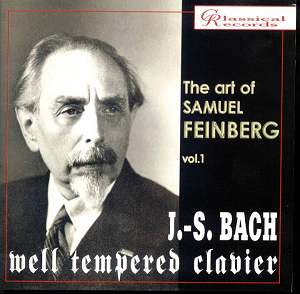
I was last aware of
Feinberg’s 48 on Russian Disc
back in the mid-nineties. Its stature
has survived over forty-five years’
scrutiny, a period that is admittedly
significantly less than Edwin Fischer’s
pioneering set – which, though older,
has always much more widely available
– but that still attests to the hold
it has exercised over admirers and detractors
alike. Naturally one can be both pro
and contra Feinberg throughout the course
of nearly four hours but one’s admiration
for the immensity of his achievement
will be undiminished.
Collectors will have
one of the previous transfers of the
set. Many will have encountered the
Russian Disc, though this became increasingly
difficult to obtain. This new transfer
doesn’t sound very different from previous
incarnations. The original recording,
I always thought, was made in 1959 but
the years of recording as given here
are 1958-61. It wasn’t in any case a
conspicuously successful recorded set
up, lacking a certain amount of clarity
and definition but it is certainly serviceable.
The performances are
remarkable and consonant with the corpus
of Feinberg’s Bach recordings from the
early German discs (on Arbiter) to the
final recordings made weeks before his
death, of which the Feinberg arrangements
of Chorale Preludes are some of the
most moving performances known to me.
Salient features are
the profound humanity of his approach,
the warmth of his playing, the constant
tempo and dynamic changes and fluctuations,
pervasive rubati and rallentandi. Tempi
can frequently be very fast though usually
– but not invariably - melodic lines
are projected with clarity. He seeks
to convey meaning through phrasal plasticity,
to sculpt through peaks and troughs
of dynamic gradations and to explore
the serious nobility of many of the
Preludes through the noblest of touches.
Such qualities can be heard in the Prelude
of the C minor of Book I; in the Prelude
of the same book’s C sharp minor he
is joyous, intensely alive to the swinging
rhythm generated by retardation and
acceleration of the rhythm. The beauty
of his voicings is plainly audible in
the Prelude of the C sharp minor, its
density of utterance in the same key’s
Fugue. The occasional rushing of the
D major Prelude can be contrasted with
the kind of rolled chord legato of the
Prelude of the E flat minor, though
it’s fair to say that Feinberg’s ethos
involves an appreciation of contrastive
tempi for some of its most immediate
impression.
The measured exultance
of the Prelude of the A flat major is
wondrous. If the momentarily confused
voicings of the Fugue in B flat major
disconcert one should be aware that
Feinberg’s vision is a personal one,
embracing the florid as well as the
patrician. His fluid tempi and beauty
of tone enhance his playing of the Prelude
in C major, which opens Book II. Playing
of this level of expressivity will occasionally
veer toward over-animation but the D
major Fugue illustrates the components
that go toward such visceral playing
– alternation of tempi, richly characterised
phraseology, exceptional voicings. If
one listens to the Prelude of the F
sharp minor one can feel that remarkable
ability to increase tension through
this myriad of means, to galvanise and
build up blocks of dynamism and then
to release and dissipate the tension.
In his hands inspiration comes fully
formed.
Richter and Feinberg
occupy differing traditions in the 48
and lucky the collector who can enjoy
both, with Fischer, on their shelves.
A more modern recording will be necessary
but for Feinberg admirers no collection
is complete without this recording.
The notes are rather concise but there
are small but excellently reproduced
photographs.
Jonathan Woolf



 Samuil Feinberg (piano)