Rossini had a wonderful
verbal wit, observing, for example,
that "One cannot judge Lohengrin
from a first hearing, and I certainly
do not intend to hear it a second time".
Or, on being shown funeral music
for Meyerbeer, written by the dead composer’s
nephew: "Very nice, but tell me frankly,
don't you think it would have been better
if it had been you who had died, and
your uncle who had written the Funeral
March?". And, of course, his musical
wit is abundantly evident in his comic
operas. It is perhaps only in his Sins
of Old Age that he brought together
comprehensively both kinds of wit.
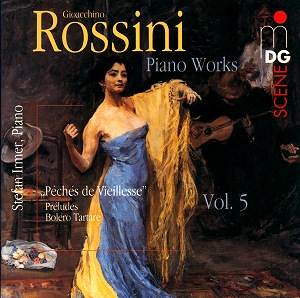
Volume 5 of Stefan
Irmer’s excellent survey of the piano
music concentrates – almost exclusively
– on pieces to which Rossini gave titles
including the word ‘Prélude’.
Irmer’s booklet notes, which are very
interesting, tell us that in the Sins
Rossini applies the word to twelve compositions;
eight of them are played here. The word
is nowhere allowed to stand alone to
give a title to a composition. Always
it has an adjectival word or phrase
to accompany it, but not necessarily
to clarify it or the music. Indeed a
number of the titles are teasingly mischievous
– we have a "so-called dramatic"
prelude, an "inoffensive"
prelude and a "semipastoral"
prelude, for example – such titles set
up complex and ironic relationships
between words and music. In some cases
the adjective does seem to promise ‘definition’
of the music – a "baroque"
prelude and a "moorish" prelude,
for instance. The latter does have a
Spanish flavour but the former owes
as much to the Viennese waltz and bel
canto opera as it owes to the baroque.
At least the "prelude fugassé"
is fugal! But even here it is probably
not irrelevant to remember that some
other French words, like ‘fugace’, meaning
transient or whimsical.
When Rossini designates
a prelude as "inoffensive"
and the actual music is, in Irmer’s
words, amongst "the most refined
and amazing of all of Rossini’s piano
compositions", should we dismiss
the title as genuinely self-deprecatory?
Or treat it as a bit of false modesty,
seeking from the listener a response
along the lines of "nut, maestro
Rossini, it is so much more than merely
inoffensive"?
In suggesting that
some of the interest in these pieces
lies in the ‘gap’ between verbalisation
and music, a gap exploited with characteristically
Rossinian wit, I don’t mean to suggest
that these piano pieces are not well-endowed
with purely musical interest. This is
witty music, often serious but never
solemn. There is some quite marvellous
writing here – from the dotted octaves
of the Prélude Moresque
to the virtuoso passages in the Prélude
Semipastorale, from the effervescence
of the Prélude Pétulant
Rococò to the almost Chopinesque
velocity of the Prélude Blaguer.
Stefan Irmer is fully
committed to this music and plays it
with considerable insight and certainty
of technique. The sound of his Steinway
D of 1901 is as well recorded as one
expects from Dabringhaus und Grimm.
Rossini was a man with
a great capacity for pleasure and for
giving pleasure to others. This CD might
fittingly be accompanied by Tournedos
Rossini or Canelloni alla Rossini, or
perhaps by some of that port from the
cellars of the Royal Household which
the king of Portugal regularly sent
as a gift to the composer. Even with
such accompaniments it is a thoroughly
enjoyable disc.
Glyn Pursglove



 Stefan Irmer (piano)