Elisabeth Schumann,
born in 1888, had a long and distinguished career, making her
debut in Hamburg as early as 1909, when she was 21. She was
still singing after the Second World War. On this disc we meet
her at the beginning of her recording career. These are not
her first recordings - they were made for Favorite in 1913 -
but the first four titles, recorded for Edison in 1915 still
catch her in her first blossoming. The sound quality on these
sides is no more than acceptable, quite dim and with a distant
orchestra. Five years later, on the earliest Polydors, there
is much more presence and the singer’s voice is close and lifelike.
The orchestra still sounds like an acoustically recorded orchestra
but it is the voice that matters. We can still enjoy all the
famous characteristics: the bell-like clarity, the exquisite
phrasing, the warmth of tone and the “face”. Alan Blyth in his
perceptive notes mentions “her inborn gift for communicating
with her audience”. Not many communicators can bring this to
the listener. Schumann’s was not a large voice and she obviously
knew its limits. Much of what can be heard here is what we normally
call soubrette repertoire. What is needed for those roles, besides
a light and agile voice is a twinkle in the eye and charm and
that’s what she had in abundance. There is not a dull moment
during the 77 minutes of this disc. Of course there are some
less desirable features and it must be up to the individual
listener how these affect listening pleasure. One is that, apart
from Exultate, Jubilate, everything, irrespective of
original language, is sung in German; this was the norm in those
days. She sometimes adopts a hooting sound, similar to what
Kirsten Flagstad sounded like at the end of her career. I believe
that this has something to do with the narrow frequency range
of the acoustical recording technique since this afflicts other
sopranos of this era as well. What can be more of an irritant
is her generous, even exaggerated, use of portamento, the method
of moving seamlessly from note to note so that the effect becomes
a slide. This was more common in the ‘good old days’ and can
be heard also on violin recordings - just listen to Fritz Kreisler.
It is a matter of taste how much portamento one can tolerate.
My first reaction when playing this disc was that Schumann’s
use of it was too much of a good thing. In some places it gives
a roller-coaster effect. I felt very disappointed with most
of her singing since this over-shadowed all the good things.
I did not recall anything similar in her later electrical recordings
which I have known and loved for decades. Having replayed the
disc several times, both through speakers and headphones, I
have begun to tolerate it. The funny thing is that while I am
writing this I am listening a last time through headphones and
now it doesn’t disturb me at all; it might be an acquired taste
after all. That said, readers who, like me, are unfamiliar with
Schumann’s early recordings, should listen before buying.
Maybe the Mozart
arias are the best things on this disc. It seems that Schumann
had a special affinity for Mozart. Either of the last two tracks,
Susanna’s aria from Le nozze di Figaro and Pamina’s aria
from Die Zauberflöte is as good a place as any to start
listening. These 1923 recordings also offer the best sound quality
with fine woodwind contributions in the Figaro aria.
It is difficult to imagine more sincere singing and it is also
a good test of one’s reactions to her portamento. Cherubino’s
two arias from Figaro (tracks 5 and 6) are also charmingly
done with lots of rubato, especially in Non so più, and
of course she was a wonderful Zerlina (tracks 7 and 12). Among
the non-Mozart numbers the aria from Lortzing’s Wildschütz
is one of the best, lively and with a fine trill. She is also
an engaged Marguerite in the Jewel song from Faust and
rides the Wagnerian orchestra in the excerpt from Hänsel
und Gretel with surprising ease.
Ward Marston, as
usual, has managed to lift as much information as possible from
the old shellacs and has wisely left some of the background
“bacon-frying” to be heard to preserve the high frequencies
of the voice.
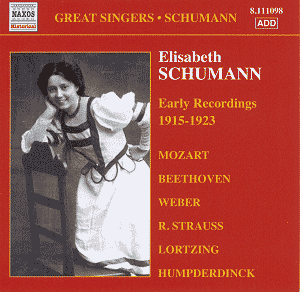
The cover photo
shows Elisabeth Schumann as Ännchen in Der Freischütz.
When writing this I listened to her singing Kommt ein schlanker
Bursch gegangen from that primitive 91-year-old Edison record
and wow what a charming singer! She sounds exactly as she looks:
fresh as dew, the tones like a valuable string of pearls streaming
effortlessly out of the headphones. And I have come to love
her portamento as well!
Göran Forsling



 Elisabeth Schumann (soprano)
with orchestra
Elisabeth Schumann (soprano)
with orchestra











