In spirit, the music of Jean Françaix, alternating passages of boulevardier
suavity with others of perky impertinence, resembles that of
his better-known countryman Francis Poulenc. But Françaix's
neo-classical textural clarity and economy - with solo brass,
particularly low trumpets, adding an insouciant edge - is the
antithesis of Poulenc's glamorous orchestral sheen. The transparent
sonorities, lively rhythms, variegated colors and quirky, playfully
dissonant harmonic language give the music an immediate appeal;
it always falls easily on the ear. Yet, owing to a lack of real
melodic invention - except here and there, in the Serenade
for Small Orchestra, for example - it doesn't really linger
in the memory.
Hyperion doesn't list either of these recordings - representing two
of the composer's nine ballets - as a premiere, I can't recall
any predecessors; practically, this album fills a discographic
gap. Unfortunately, it doesn't always fill it very well. In
Le roi nu, based on Andersen's Emperor's New Clothes,
the strings sound thin and pallid almost throughout. In the
episode where the King "puts on" his new garment (tr.
10), the soloists are accurate, but dry and stingy. In the tricky
passage at 2:29, the violins' tentative intonation turns downright
scraggy at 2:45. Nor do they muster sufficient tone to fill
out the various climaxes, especially against the winds and rolling
percussion; only in Scene 4 (tr. 11) do we finally hear a plausibly
full tutti sonority. Since the Ulster strings sound rich,
warm and generally presentable on their Chandos recordings,
I'm not sure what accounts for their threadbare tone here. Perhaps
the intent was to replicate the reduced proportions of a pit
orchestra, a poor idea in any case.
Or perhaps that piece simply needed more rehearsal time, for the strings
sound rather better in Les demoiselles de la nuit, which
serves to improve the entire effect. The horn's square phrasing
in the opening Nocturne is demoralizing, but the pointillistic
bits of figuration in the scene that follows are nicely buoyant;
the ensuing violin solo is vibrant and full-toned; the slow
waltz for Agathe's entrance is tenderly phrased. In Scene 2,
the writing for legato woodwinds over pizzicato strings - a
characteristic balletic Françaix texture - sounds graceful and
bright-eyed. Indeed, the woodwind and brass playing in both
scores is pretty much above reproach. The climax of the General
procession ought to be splashier, but the strings bring
a nice warmth to their theme in Agathe and the young man.
I'd still like to hear the score played by a larger-sounding
orchestra, but this performance at least conveys the right overall
feeling.
Hyperion's sound is pleasant but puzzling: the reasonably warm, spacious
ambience we hear around the reeds and brass somehow isn't doing
much for the strings. In Les demoiselles de la nuit,
the woodwinds and horn occasionally sound synthetic - literally,
as if produced by a synthesizer.
The rarity of the repertoire notwithstanding, this is for Françaix
completists only.
Stephen Francis Vasta



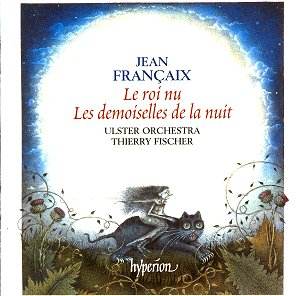

 Ulster Orchestra/Thierry Fischer











