In
each of these scores for the ballet, Stravinsky’s starting
point was music by earlier composers. The nature of his response
is various, so much so as to challenge any simple ideas as
to what ‘originality’ is. Pulcinella was, at the time
of its first performance, described as employing music by
“Igor Stravinsky d’après Giambattista Pergolesi”. The Fairy’s
Kiss carried the subtitle ‘Allegorical Ballet in Four
Tableaux, Inspired by the Muse of Tchaikovsky’.
The
sources for Pulcinella were actually something of a
ragbag. Much of the music was not by Pergolesi at all – though
generally believed to be so at the time, as in the case of
the trio sonatas by the Venetian violinist Domenico Gallo
which were published as Pergolesi’s in 1786. In one sense,
none of this matters, for the music is, paradoxically, pure
Stravinsky; indeed it represents the very moment at which
Stravinsky discovered important dimensions of his own musical
- and personal? - identity.
In
Expositions and Developments (1962) Stravinsky provides
a fascinating account of the composition of Pulcinella:
“Pulcinella was the swansong of my Swiss years. It
was composed in a small attic room of the Maison Bornand in
Morges, a room crowded by a cimbalom, a piano, a harmonium,
and a whole cuisine of percussion instruments. I began
by composing on the Pergolesi manuscripts themselves, as though
I were correcting an old work of my own. I began without preconceptions
or aesthetic attitudes, and I could not have predicted anything
about the result. I knew that I could produce a ‘forgery’
of Pergolesi because my motor habits are so different; at
best, I could repeat him in my own accent. That the result
was to some extent a satire was probably inevitable – who
could have treated that material in 1919 without satire?
– but even this observation is hindsight; I did not set out
to compose a satire ... the remarkable thing about Pulcinella
is not how much but how little has been changed”. Most of
what we need to know about the work is here. What the attentive
listener soon realises, however, is how much of a change is
brought about by the ‘little’ that has been changed. All the
small emendations of accent and harmony, all the subtle, if
pungent, harmonic changes produce a work which we can recognise
– with, indeed, the advantage of hindsight – as quintessential
Stravinsky. Looking back, at the time of Expositions and
Developments, Stravinsky himself saw the works significance
very clearly: “Pulcinella was my discovery of the past,
the epiphany through which the whole of my late work became
possible. It was a backward look, of course – the first of
many love affairs in that direction – but it was a look in
the mirror, too”.
What
we are given here is not the more familiar eleven movement
suite, but the entire score, meticulously conducted by Craft.
As ever, Craft is very faithful to Stravinsky’s score; his
soloists are convincing, for the most part, (especially Montagu)
and the orchestra copes admirably with the brisk tempi. Excellent
value as a reliable account of an important – and entertaining
– work.
Its
partner here is The Fairy’s Kiss (or La baisée de
la fée), for which Stravinsky’s sources were youthful
works by his great Russian predecessor, mostly songs and piano
pieces. For the most part Tchaikovsky’s melodies remain intact,
but the works are handled with far more freedom than those
of Pergolesi (or pseudo-Pergolesi) had been earlier. I have
never really warmed to this work and Robert Craft’s version
hasn’t charmed me into submission. There is an affectionate,
nostalgic quality to the exiled Stravinsky’s use of Russian
materials and a governing elegance, but the whole strikes
me, in this performance, as rather bland – certainly compared
to the vivacity of Pulcinella. Not a bad performance,
by any means, but not quite as persuasive as, say, that by
Knussen with the Cleveland Orchestra on Deutsche Grammophon.
Both
these performances were previously issued on Koch, in different
couplings. They are intelligently put side-by-side on this
Naxos reissue, which is supplied with useful notes by Craft
and with full texts and translations. Despite my slight reservations
about The Fairy’s Kiss, this is warmly recommended.
Glyn Pursglove
BUY NOW
AmazonUK
AmazonUS



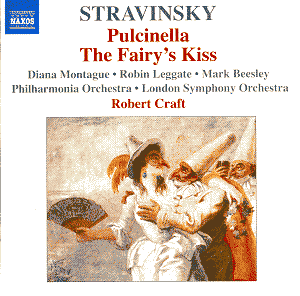
 *Diana Montagu (mezzo),
Robin Leggate (tenor), Mark Beesley (bass)
*Diana Montagu (mezzo),
Robin Leggate (tenor), Mark Beesley (bass)











