"A sad idea that
one can dance", is Udo Salzbrenner’s
heading to his essay on tango in the
booklet for this issue. Little is known
about the origin of the word ‘tang’,
but one theory says that it is African
and related to "tambo" (drum).
Another idea is that it is the verb
"tang" (to touch). Somewhere
around 1880 it seems that the tango
appeared in the brothels of Buenos Aires
derived from the habanera. It is also
an interesting fact, not mentioned in
the essay, that in Europe the dance
is firmly established in Finland of
all countries. There it is enormously
popular. It seems that every individual
in Finland can dance the tango and every
year a King of Tango is chosen. Possibly
it is the melancholy of the music -
a sad idea that one can dance - that
appeals to the Finns.
"Piazzolla’s tangos
are not danceable, at least not in the
conventional sense. They demand rather
concentrated listening", maintains
Salzbrenner. He refers to the composer’s
use of harmonies borrowed from jazz
but also from Stravinsky and Bartók.
It is indeed fascinating and remarkable
what Piazzolla can extract from the
tango, constantly finding new ways to
widen its expressive scope. His works
are through-composed with lots of changes
in tempo, in dynamics, in instrumentation
and in rhythm. Sometimes he writes thrilling
counterpoint (he was a great admirer
of Bach’s) – the Fugata, the
first movement of Tangata – Silfo
y Ondina is a good example. Sometimes,
as in the Final of the same suite,
the pianist is suddenly let loose in
a hilarious jazz solo, backed up by
the double bass. Much of the music is
built up from fragments, short phrases
that are repeated, changed, transposed.
They rarely develop into long-drawn
melodies, even though he can write lovely
tunes too. It is all very unpredictable
– anything can happen so have to keep
a good look-out; stimulating stuff.
Maybe the most fascinating
work on this disc is Estaciones Porteñas
which is Piazzolla’s own
"The Four Seasons" – constantly
bristling with ideas and the last movement,
Invierno Porteño (track
9) also a piece of extreme melodic beauty.
What is possibly his greatest hit, Libertango,
is played as an encore and with real
gusto!
The five musicians
are German but they all have a deep
love of this music and at least the
pianist, Fabian Dobler, has lived in
Buenos Aires and imbibed the atmosphere.
With the bandoneon providing the authentic
colour this disc conveys a slightly
exotic message, at least to a North
European; a message that makes at least
this listener eager to get to know the
music even better and decode this message.
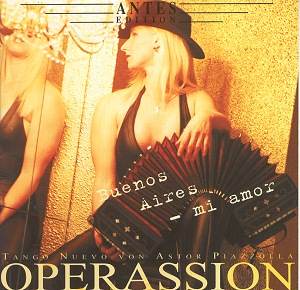
By the way, Piazzolla also played this
instrument, the Argentinean accordion,
which can be seen on the cover picture.
Piazzolla’s world is
very much his own and delving into it
pays dividends. This as good a place
as any to start delving for the not-yet-converted.
The only black mark, which is a serious
one, is the design of the booklet with
the small print in white on black or,
even worse, white on yellow! Don’t they
ever read their own products? Another
disc from the same company, Mozart
for mandolin and guitar, was exemplary
in this respect but this disc is obviously
aimed at a more popular market where
flashy design is all-important – to
the detriment of decipherability. Shame!
Göran Forsling



 Operassion: Fabian Dobler (piano), Antje Steen
(bandoneon), Susanne Hofmann (violin), Maya Valcheva
(double bass), Rares Popsa (guitar)
Operassion: Fabian Dobler (piano), Antje Steen
(bandoneon), Susanne Hofmann (violin), Maya Valcheva
(double bass), Rares Popsa (guitar)