Not much of Frank Ezra Levy’s musical
output has been committed to disc —
in looking at what is currently available
on various web sites, I have found a
cello concerto (his first) and his fourth
symphony. Here, then, is a special contribution
towards the wider distribution of this
composer’s music.
A Summer Overture
manages to sound like an American
overture without also sounding like
Copland or Bernstein, which, by other
examples out there, is no mean feat.
It has moments both exciting and sinister.
The work is based on the tune "Sumer
is icumen in," which is reduced
to fragments that are treated contrapuntally.
This is an easily accessible piece that
will appeal both to early music enthusiasts
as well as to those that enjoy dynamic,
extrovert music.
The Second Cello
Concerto, a work of 2002 performed
by its dedicatee, begins on the same
note A Summer Overture returned
to so insistently in its coda. In his
notes, the composer refers to a process
of "kaleidoscopic variation"
as the basis for this composition. Indeed,
the movements focus on broad variations
that change guise. The first movement
ends seemingly in mid-sentence, with
the contrasting narrative of the second
movement as a sudden change of heart.
Reminiscent of Shostakovich, this movement
has the solo instrument and orchestral
forces trading the narrative line and,
rather often, in conflict with each
other for dominance. The Allegro
is a manic, driving force in the orchestra,
with the solo instrument acting almost
as a retarding agent, tempering the
outbursts of the collected ensemble.
Though Shostakovich comes to mind, this
is a work that has none of the mind-spinning
Shostakovich cadenzas; instead it seems
to focus on pitting the orchestra against
the solo instrument.
Rondo Tarantella
of 2003 begins ominously with low
winds, then transfers its unease, its
syncopated jig-like theme, to the strings
and upper woodwinds. This work has been
incorporated into the opera Mother’s
Day as the finale to Act 2, where,
in an effort to gain entry to a women’s
political movement, the President’s
husband disguises himself as a woman
to infiltrate a demonstration. It is
a piece of tension and anticipation.
The Third Symphony
of 1977 is a much earlier work than
the others presented here. It is a weightier
example of the basic method employed
by Levy, which consists of an initial
basic narration of a theme from which
variations arise. Some of the mutations
are more radical than others before
the original statement returns. Odd
elements and figures at the end foreshadow
the second movement, which continues
from the first without a break; a steady
building of the material that has been
presented. With a restrained gong blow,
the movement is driven back to a taut
quiet section before the ensemble takes
courage behind the horn’s restatement.
From there, the orchestral forces gather
finally to a military force that ends
abruptly with a flurry of woodwinds.
The side-drum motif that heralds this
last movement and takes us through to
the end is a recurrence of the same
figure that reminds one of Shostakovich
in the cello concerto.
The sound quality of
this disc fits in well with the overall
quality of the Naxos releases. In the
cello concerto, the solo instrument
is warmly presented, well-balanced with
the orchestra, and exceedingly well-played
by Ballantyne.
David Blomenberg



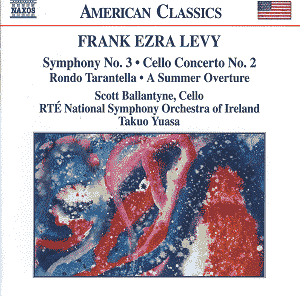
 Scott Ballantyne (Cello)











