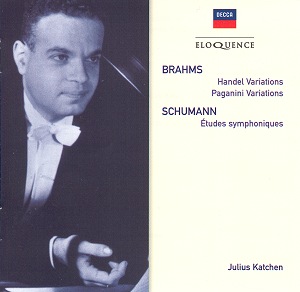
Preferring my LP Brahms
from old-timers or the likes of Klien
(CD: Vox Classics 3612), Gilels, Kovacevich,
Lupu or Michelangeli, I always regarded
Katchen’s Decca cycle from the mid-1960s
(CD: Decca 455247-2) as a variable standby
of the stereo age, useful in part but
spiritually slender. Pre-dating that
project, the present mono accounts are
of lesser calibre. You get all the notes
- well most anyway: some get lost through
excessive speed or untidy pedalling
- but without much fantasy, refinement,
or rhythmic tension. And with only occasional
charm (Handel 5, 11, 12, a deliberated
‘Hungarian’ 13, 20, 22; Paganini
I/11, 12; II/4, 5, 12). The theme of
the Handel (the first large-scale
piece JK taped for Decca, in April 1949)
stays earth-bound; that of the Paganini,
paradoxically beautified, fights shy
of the devil. Come the puissance fences,
Katchen clears them easily enough, but
isolates rather than integrates the
experience. Not for the first or last
time, taking refuge in mechanics before
musicality proves his Achilles heel
– there’s a limit to the number of bionic
thrills you can take - V10-powered
contrary octaves, snow-boarding
semiquavers … Paganini II/11,
14 [5:48, 8:27] - before praying for
something subtler and more humanly vulnerable.
Under-produced, both works disappoint
climactically. The Handel fugue
demands greater monumentality than a
contra B flat at the end. And
the final pages of both Paganini
books - no repetition of the theme before
II - lack prudence, their thumping and
floundering for air - forewarned from
Book I/4; Handel 24, 25 - descending
into undisciplined spectacle.
The Schumann, Katchen’s
only version of the work, follows the
longer first edition (twelve
study-variations), but omits the Supplement.
I detect cool efficiency and a rush
of adrenalin in the ‘concert’-style
finish, but not so much warmth – one
or two special moments apart (Var 2;
the penultimate ‘old world’ G sharp
minor, finely peaked). The 1955 Record
Guide (Sackville-West/Shawe-Taylor)
thought the performance wasn’t ‘among
the best things this remarkable pianist
has recorded. Some of the quick variations
are rushed off their feet: in No 9 -
with Clara Schumann’s second repeat,
omitted from the Sauer text - no pianist,
however steel-fingered, could expect
to give us all the notes at so breakneck
a speed. The recording is hollow [school
hall].’ Geza Anda on Columbia (second
edition) was the preferred choice of
the day (CD: Testament SBT 1069).
Katchen admirers will
want these first releases in CD format.
Old mono edits, analogue tape pre-echo,
and artless changes of ambience between
takes or numbers remain, however. Tracking
is ungenerous: Brilliant (in a Brahms
box worth dipping into [92182/3-4])
gives separate idents for each variation
– all 53 of them.
Ateş Orga



 Julius Katchen (piano)