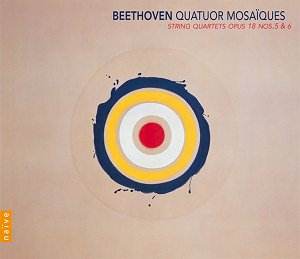
The
Quatuor Mosaïques has gained an outstanding reputation in
the quartet repertoire of the late 18th century and is certainly
the greatest quartet ensemble of our time performing on
authentic instruments. Mosaïques, celebrated the world over
for its ‘period-style’ interpretations, at the same time
never lose sight of the precious European quartet tradition.
Following its benchmark recordings of the Haydn, Mendelssohn
and Mozart quartets, all on the Naïve label, it is clear
that Mosaïques is in perfect phase to interpret the new
world explored by the young Beethoven in these Op. 18 string
quartets.
Op.
18 saw the twenty-eight year old Beethoven, now deep into
his first creative period, exploring what was new compositional
territory. He had at the time already written a wide range
of chamber music, including three piano quartets when he
was fifteen, string trios, piano trios, an octet for winds,
a quintet for piano and winds, cello sonatas and violin
sonatas. Previously he had kept a respectful distance from
the classical quartet, a genre that had reached the peak
of its development, so profoundly marked by Haydn and Mozart.
The impetus for launching out on this challenging compositional
terrain finally came in late 1798 in response to a commission
for a package of six string quartets from Prince
Lobkowitz, who was a native of Bohemia and a leading patron
of the arts in Vienna. Though thoroughly grounded in the
classical tradition of Haydn and Mozart, the quartets continually
demonstrate new attitudes, techniques and nuances of expression.
To many the quartets in the Op. 18 set are the most important
works ever conceived in the form. For the time, in these
quartets, the remarkable innovation and incredible experimentation
evinced by Beethoven’s later quartets are subservient to
an exuberance and tranquil grace that belong to an older
order.
The
turn of the century was an extremely significant period
for Beethoven, as shortly after completing the set he was
to astound the music world with masterworks such as the
Piano Concerto No. 2 in B flat major, Symphony No. 1 in
C major, Septet in E flat major, Violin Sonata No. 5 in
F major ‘Spring’, Piano Sonata in C sharp minor ‘Moonlight’,
Symphony No. 2 in D major and the Piano Concerto No. 3 in
C minor. All this in a period when Beethoven had confided
to close friends that his hearing was rapidly deteriorating.
The
String Quartet in A major, Op. 18, No.5 was actually the
fourth work in the set to be composed. The similarities
to Mozart’s Quartet in A major, K464, that Beethoven knew
thoroughly, is clear. For example they share the same key
and the formal structure is identical.
The
charming opening movement allegro, dominated by the
role of the first violin of Erich Höbarth, is played with
intensity and perhaps too much seriousness. The menuetto
with its contrasting trio is given a reasonable
lively reading but the movement lacks sparkle and there
are some episodes of hesitancy. Marked andante cantabile
the slow movement is performed with a mournful reverence
and with the expertly controlled pace that has become a
speciality of this group. The concluding movement allegro
is made to sound striding and airy.
The
String Quartet in B flat major, Op. 18, No.6 contains one
of the most tragic pages found in the entire set. The opening
movement allegro con brio with its appealing and
light-footed first subject is performed with grace and significant
artistry. In the allegro ma non troppo the players
produce a performance of splendid temperament and finesse.
The scherzo with its effective syncopations and whimsical
trio is suitably energised. Beethoven entitled the
final movement ‘melancholy’ and insisted that it
be played, “with the greatest of delicacy.” Many
writers have commented on the brief anguished slow passage
at the start of the movement as the real beginning of Romanticism
in music. The quicker music that follows in the movement
rejects sorrow and embarks on a more convivial mood that
the Mosaïques interpret with consummate perception and authority.
Across
both works the quartet play with commendable purity of sound
offering interpretations of integrity and consummate artistry.
The contrast between some of the movements would I feel
have benefited from a more marked approach. However Quatuor
Mosaïques have no serious competition as a period-instrument
ensemble.
They
have already released numbers 1 and 4 of Op 18 on Naïve
E 8899 with numbers 2 and 3 to come on a future volume.
For now those wanting a complete Op. 18 set will have to
look elsewhere. On modern instruments my preferred version
of the six is from the Italian Quartet, recorded in Switzerland
between 1972 and 1975 and presented in a three disc boxed
set on Philips 464 071-2. Also worthy of consideration are
the Talich on Calliope, who I believe were the first to
accommodate all six works on two discs, available on two
volumes; CAL 9633 (Nos. 1-3) and CAL 9634 (Nos. 4-6). Both
these analogue sets from the Italian and the Talich have
been digitally remastered, repackaged and re-released at
bargain price. A third modern instrument version that I
would not wish to be without is the digital set from the
Alban Berg Quartet. They offer fine live performances recorded
in Vienna in 1989 and offer them across two discs presented
on the bargain priced ‘Great Artists of the Century’ series
(EMI Classics 5627782).
These
are first class performances from Quatuor Mosaïques enhanced
by a most natural sound quality. Lovers of period-instrument
performances need not hesitate.
Michael
Cookson