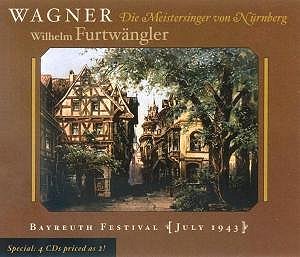
A real treat, but be
warned this is not a complete Meistersinger
- there are gaps. But my word, it is
worth it to experience Furtwängler's
astonishing grasp of this huge score.
This is Furtwängler the Light,
entirely in touch with the aura this
piece projects.
The performance is
taken from 1943's Bayreuth Fetsival.
The transfer level is fairly high, and
strings can appear gritty and edgy,
yet none of this can obscure Furtwängler's
dignified conception of the Overture.
Trills still buzz with energy, and the
conductor's shaping of lyric melody
is a thing of wonder.
Of the names in the
cast list, possibly Josef Greindl was
the greatest, and certainly his Pogner
is one of the greatest assumptions this
reviewer has heard. Greindl exhibits
great depth of sound, and his 'Das schöne
Fest Johannistag' is simply beautiful
against a bed of sound in the orchestra.
In Walther (the great
Max Lorenz), one hears a wonderful singer,
to begin with obviously reining his
voice in. He is unleashed for 'Am stillen
Herd'. David (Erich Zimmermann) is hugely
characterful. Sachs is Jaro Prohaska.
I question whether this Sachs projects
the requisite authority (his 'Halt,
Meister!' towards the end of Act 1,
for example), and right from the start
he sounds on the tired side.
Throughout Act 1, Furtwängler
inspires the Bayreuth orchestra to produce
miracles. He never for a second merely
accompanies, always fully aware of the
Wagnerian tapestry in front of him.
The happy-go-lucky
youthful swing of the opening of Act
2 is perhaps a little pressed by Furtwängler,
although it does settle into some sort
of a lilt. It is in Scene 2 that Furtwängler
comes into his own, moulding the strings
so expressively against Greindl's voice.
Worth noting, too, that the Magdalene
and Eva (Müller and Kallab) work
so well together, their voices complementing
each other. All of which seems in retrospect
but preparation for Prohaska's Fliedermonolog.
Here the distant horns are so many hunting
horns, and if Prohaska's first part
of this monologue is not fully involving,
the sadness of the remainder more than
makes up for it.
Müller comes into
her own in Scene 5 ('Da ist er! - Ja,
Ihr seid es!'), her impassioned duet
with Walther rising to a natural climax,
only to be interrupted by the Nightwatchman.
Furtwängler coaxes from the orchestra
during these scenes the most astonishing
delicacy. A pity the Nightwatchman himself
(Erich Pina) sounds nervous.
There is wit in this
act too - not something that immediately
springs to mind with Furtwängler!
- around the discovery of Beckmesser
and the depiction of the stage's chaos.
If one needs any proof
as to Furtwängler's genius, one
need only go to the Prelude to Act 3
- in fact, maybe even the first note
thereof, which seems to immediately
conjure up this first scene's special
atmosphere. Note also the gorgeous horns
- mellow and refined - and the real
explosion of emotion at 5'57. True,
the ensemble is not perfect as we shift
into the action of the final act.
Here it is Sachs’ Wahn
monologue that impresses. Believably
world-weary, Prohaska is infinitely
human. It is only later in the act that
he appears not to have the truly 'paternal'
touch. Lorenz, after Furtwängler's
glowing preparation, really opens out
for his 'Morgenlich leuchtend'.
If any act proves that
this is Furtwängler's Meistersinger,
it is this long Act 3. He paces it to
perfection, with the end truly climactic.
Certainly from Walther's Preislied onwards
this sits at the very top of the Meistersinger
tree, and all sonic limitations become
irrelevant.
Good to have a second
stab on CD4 at the Meistersinger
apple in the Act 1 Prelude (BPO, February
29th, 1949), more assured
in sound, plus a glowing 'Karfreitagszauber',
Siegfried's Funeral March and a Prelude
and Transfiguration from Tristan
to close the set. But it is in the Bayreuth
Meistersinger that this set's
value lies, and for which we should
be ever grateful, despite the missing
sections.
Colin Clarke



 Berliner Philharmoniker/Wilhelm Furtwängler.