This release is available
as a DVD and a hybrid SACD counterpart.
Joan Grossman’s film
illustrates Yellow Stars with
film footage from a variety of sources
and locations, travelling in a rough
chronological arc from book burning
and shop-boycotting (well known images)
to the liquidation of the Warsaw and
Kovno ghettos. There are also scenes
from Dombrova in Poland, the occupation
of Lithuania, still shots and, most
innovatively, contemporary colour
footage, taken from a car, of the
countryside between Treblinka and
Warsaw. It’s used to illustrate the
Nocturne movement.
Among the much unusual
footage one can see film of a choral
concert and straight-to-camera shots
of crowds in the ghettos. In the third
movement, Merry Dance, we see stills
of musicians and others, many of them
children. Street crowds throng throughout
Evening Prayer, the sixth movement
including significantly the ill and
beggars. In the finale we see the
transports and the liquidation of
the ghettos, especially that of Kovno
in 1944 and Warsaw. The film then
attempts to present images of the
Holocaust experience as a visual analogue
to Schwartz’s music.
Schwartz was born
in 1923 and suffered the brutal realities
of life in the Soviet Union. His father
was arrested and died in one of Stalin’s
camps and the family was sent to Kyrgystan.
There he met Shostakovich’s sister
Maria Dmitrievna, similarly banished,
and it was she who arranged accommodation
in Leningrad when the family was allowed
to return to Russia after the War.
It was her brother who recommended
he study with Boris Arapov – and secretly
financed those studies. Schwartz refused
to denounce Shostakovich in 1948,
despite provocation, and managed to
produce a stream of works following
his graduation in 1951. He later moved
towards film music, writing a raft
of scores for a succession of films,
many of them very well known, and
only returned to symphonic music in
his seventies.
Yellow Stars
or Purim spiel in the ghetto
was one of the fruits of that return,
subtitled a concerto for orchestra
in seven parts. It received its first
performance in 1998. The work owes
its genesis to Schwartz reading an
account of life during the War in
the Kovno ghetto in Lithuania. The
Purim festival, a time of joyfulness,
was a particular focus - it became
"a festival of nooses" in
the camp. Schwartz’s work is dedicated
jointly to Raoul Wallenberg and to
Vladimir Spivakov, who didn’t conduct
the premiere but who conducts this
recording.
It’s hard to be other
than descriptive when considering
a work such as this. Opening with
a morning prayer we find gravity and
serenity fused – a stetl dance, clarinet
klezmer, strong shofar horns as the
music sweeps up and then - once more
- relaxation into reflective intimacy
led by a theme for solo cello. Again
the juxtapositions ramify with the
return of the dance, augmented by
solos for violin and trumpet; the
whole forming a kaleidoscopic world,
Mahlerian and with elements of Shostakovich
as well. The second movement is a
Chorale with variations, once more
lit by clarinet dance and by an outsize
violin solo. There are the merest
hints of Sibelius in the writing that
cleaves strongly to an early twentieth
century tonal muse throughout. In
the central Dance – a kind of Scherzo
- there’s a riot of colour with bassoon,
bass clarinet and other winds festively
celebrating with unbridled freedom.
This is followed by the reflective,
refractive Nocturne – lyrical, maybe
filmic, Mahlerian, sometimes ambiguous.
The fifth movement is almost parodically
Jewish – thick portamenti, whilst
the sixth embraces desolate trumpet
calls, a hint of Rachmaninov’s Second
Symphony – abruptly cut short. The
Finale opens with a forlorn clarinet,
increasing melancholy, until tense
brass drives the writing onwards.
Slow, sombre, though seemingly ultimately
uplifting, the return of klezmer tune
presages a fast dance and the music
gets quicker and quicker. Defiance?
A Shostakovich Eighth Quartet
Dance of Death? Maybe both.
The performances
are highly accomplished and present
Schwartz’s music with warmth, rhythmic
tautness and bite. They don’t underplay
the occasional moments of Rimsky-like
lyricism nor the Mahlerian marches.
Much is moving, compelling and often
filmic in its intense immediacy.
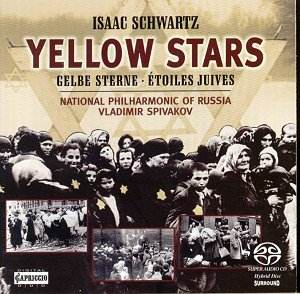 Isaac
SCHWARTZ (b.1923)
Isaac
SCHWARTZ (b.1923)
Yellow Stars, concerto for
orchestra in seven parts (1998)
 National Philharmonic of Russia/Vladimir
Spivakov
National Philharmonic of Russia/Vladimir
Spivakov
Recorded at Svetlanov’s Hall, Moscow,
May 2004
 CAPRICCIO SACD 71 027 [57.44]
AmazonUK
Amazon
US
Jonathan Woolf



 CAPRICCIO
DVD 93 508 [57.44]
CAPRICCIO
DVD 93 508 [57.44] 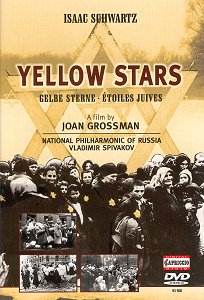
 for
details
for
details











