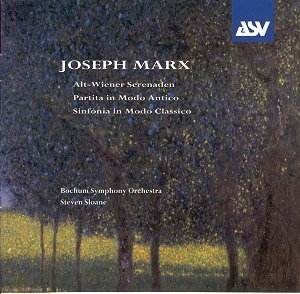
The works on this program,
though substantial and pleasing, are
apparently not representative of the
music of Joseph Marx. This self-taught
composer, after writing in a predominantly
Impressionist idiom for most of his
life turned towards the end of his career
to classicism for inspiration. Rather
than following the severe neo-classic
style favored by Stravinsky and others,
Marx adopted classical musical structures
as a compositional framework, infusing
them with rich chromatics and variegated
timbres.
Thus, the Alt-Wiener
Serenaden, commissioned for the
Vienna Philharmonic's centenary, is
an original, affectionate homage to
Classical models, rather than a modern
arrangement of old originals à
la Respighi. Each of the four movements
bears earmarks of the Classical period:
the ABACA form of the first, the quietly
clanking harpsichord in the Aria,
the third movement's graceful, Ländlerisch
lilt, the finale's fugal start. But
chromatic, mildly dissonant harmonic
gestures, along with side-steps to distant
harmonic regions, keep each movement's
pleasing, "old-fashioned" material planted
firmly in more modern times.
According to the notes,
the Partita - originally written
for string quartet, as was the Sinfonia
- attempts "to combine sacred music
with the strictly linear techniques
of a Palestrina or an Orlando di Lasso."
But it doesn't sound particularly antique.
The use of modal harmonies gives the
score an oddly English cast: certainly
the first movement's undulating motion,
and the gently scherzando impulse
that dominates the second, bring Vaughan
Williams's string music to mind. Where
Marx scores over his British counterpart,
however, is in clarity of texture: the
string sonorities cover a five-octave
range, yet the individual strands are
clearly distinguishable at all times.
The remaining movements are a broad,
introspective Adagio molto, in
which the occasionally emergent chant-like
"solo" lines more keenly evoke the older
models, and a concluding Vivace launched
by a bouncy fugue.
The textures of the
Sinfonia are cleaner and more
rigorous, yet its harmonic palette,
paradoxically, is warmly expansive.
The opening Allegro con brio
is graceful and well-proportioned. The
searching Adagio ma non troppo
grows more overtly expressive as it
proceeds. The third movement, headed
Tempo di minuetto, most strongly
underscores the Classical connections:
its shapely main theme is Haydnesque,
though more romantically fleshed out,
while its Trio unfolds over a drone
bass. The lilting theme of the finale
again makes vaguely British sounds,
until a translucent, Menottian waltz
sings out in a distant key.
Typical Marx or not,
this is immensely enjoyable music, and
it sounds as if the orchestra was enjoying
it as well. The Bochum Symphony I remember
from Turnabout LPs was a scrappy, depressing
ensemble, but under Steven Sloane's
direction they sound transformed. The
strings' phrasing is trim and neatly
sculpted - think of the early work of
Colin Davis - and the principal oboe,
who has extensive solo exposure in the
Serenaden, plays with an appealingly
plaintive tone and poignant expression.
The subtly ambient engineering is excellent.
Stephen Francis
Vasta



 Bochum Symphony Orchestra/Steven Sloane