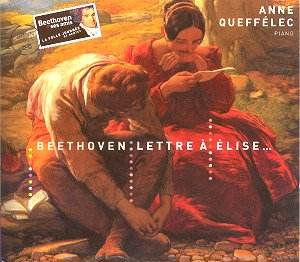
Beethoven won much
of his early fame in Vienna not as a
composer, but as a virtuoso pianist.
A formidable talent, when he did begin
to compose works for his own instrument,
the results were spectacular and revolutionary.
But for the most part, we remember him
as the composer of the thirty-two great
sonatas, the five grand concerti and
the more expansive sets of variations
such as the Diabelli and the
Variations in c minor. What is sadly
overlooked was his unique ability as
a miniaturist. Usually relegated to
student recitals and youthful piano
lessons, there is a wealth of little
jewels from the pen of the great master
from Bonn, music that perhaps is brief
and even at times simple, but beautiful
and poetic just the same. Perhaps we
can thank the composer’s tendency to
fall in love with every pretty girl
he met for this bounty of charming,
often dedicatory works that grace this
delightful recital by Anne Queffélec.
Opening with what is
perhaps the most notoriously over-played
and most often massacred piece in the
piano literature; Für Elise is
the bane of every piano store owner
in the world. Alas and alack, because
when played by an artist as elegant
and graceful as Ms. Queffélec,
it comes to life anew and regains its
luster as a true poetic gem. Not heard
as often as they should be, we are next
treated to the variations on God
Save the King, a work packed with
little outbursts of virtuoso display,
while at the same time being respectful
of its English national importance.
One of the great delights
of this recital is the inclusion of
the Andante favori in F major,
a work that was excised from the Waldstein
sonata, but having found such favor
(no pun intended) with its composer
that he published the work as a stand-alone
entity and indeed programmed it on his
own recitals with considerable frequency.
It is truly a thing of beauty and Ms.
Queffélec brings it to life again
with great deftness.
One wonders if the
inclusion of the over recorded Moonlight
sonata was some bean counter’s idea
of a selling point. Although it is played
here with great subtlety, it is a bit
out of place in this recital of miniatures.
That is not to detract from this reading
at all, in which Queffélec demonstrates
that she has plenty of melancholy (without
going overboard) for the first movement,
much ladylike charm for the second,
and abundant pathos (with the technique
to pull it off) in the third movement.
Next on the program
are the works which I personally think
make this whole disc worth the monetary
outlay. That is, the beautifully played
survey of a handful of Beethoven’s charming
little Bagatelles. Perhaps not the most
technically challenging music in the
repertoire, they still require a large
measure of taste to make them appear
as what they are: carefully crafted
pieces designed to impress and charm
the listener, usually a very specific
one.
The program continues
with the famous Rage over a Lost
Penny which although it is frequently
assigned to students, is a work that
requires a monster technique and when
done well, is an audience pleaser deserving
of its fame. To wrap things up, we have
the Variations in F, although not as
profound and difficult as the Diabellis
or the C minor variations, still
contain much to say musically and technically.
I must confess that
this is one of the most charming piano
recitals that I have come across in
years and it is a most welcome addition
to my shelves. Having only heard Anne
Queffélec in French repertoire
heretofore, it is nice to experience
this artist in a venture further afield.
She has plenty to say, and all the tools
with which to say it. Let us hope that
we hear from her more frequently in
the future.
Kevin Sutton



 Anne Queffélec, piano